Sunday, February 04, 2007

TOMAS OSMEÑA AND THE VIGILANTES OF CEBU CITY

If there is any local politician who has managed to court controversy for the alleged presence of vigilante groups in his turf other than Davao City Mayor Rodrigo Duterte, it is Cebu City Mayor Tomas Osmeña. He admits there are such groups in his area of responsibility, but says “that’s the way it is” and says he “cannot” take a “stronger stance” against them. His critics, though, think he can and should do otherwise.

BY ALEXANDER MARTIN REMOLLINO
Bulatlat


If there is any local politician who has managed to court controversy for the alleged presence of vigilante groups in his turf other than Davao City Mayor Rodrigo Duterte, it is Cebu City Mayor Tomas Osmeña –- a brother of Sen. Sergio Osmeña III.

Taxi drivers, whose vehicles are the main mode of transportation in Cebu City, are wont to talk about these vigilante groups –- among other things –- when they sense their passengers are new in the place. One of them even told this writer stories about convicts about to be released from jail after serving their term, who beg to be allowed to remain in prison lest the vigilantes go after their heads when they get out.

In a recent interview with Bulatlat, Osmeña admitted that there are indeed vigilante groups in Cebu City. By his own account, these vigilante groups killed some 170 persons last year. Most of the victims, he said, were suspected criminals.

“It’s an issue against me,” Osmeña admitted, as he acknowledged having come under fire from human rights organizations and lawyers’ groups on this issue.

The Cebu City mayor said he started getting flak on the issue of vigilantism in Cebu City the other year, when he rewarded a man who shot a robber after witnessing the crime. While driving his car, the man, he said, saw someone rob and shoot a security guard inside a jeepney he had been following. Osmeña said the robber was laughing as he went down from the jeepney a few minutes later. The man who had seen it all was armed and he opened his window and shot the robber –- and he didn’t surrender to the police.

“I told them, ‘You find that guy and I’ll give him a reward,’ and they did find him and I did give him a reward,” Osmeña said.

The Cebu City mayor, however, also expressed “regret” that these vigilante groups operate with “some consent” from his constituency.

“They get considerable support from the people, that’s the problem,” he said. “That’s because the people are losing confidence in the justice system. When they see that the fiscals and judges are corrupt; when they see drug lords, after being arrested with a kilo of shabu, get released on bail when they should get the death penalty –- you know, these are situations when people see criminals being shot dead they think, well, that’s his problem.”

Osmeña would not give figures on the crime rate in Cebu City even when asked. He did tell this writer something, however, that points to high criminal activity in the place. “There’s no one in Cebu who does not have a relative or does not know someone who has been a victim of crime,” he said.

On taking a strong stand on vigilantism

The Cebu City mayor admitted he has been under pressure to “take a strong stand” against the presence of vigilante groups in his turf. “But I do not want to give an assurance to criminals that it’s safe here, because many of them left Cebu,” he said.

He has many critics, though, who think he can –- and should –- do otherwise. They say that leaving vigilantes to act on the problem of criminality has implications on human rights.

Osmeña has defended what his critics describe as his “inaction” in the face of these killings, saying the vigilante groups help in reducing crime in Cebu City.

“If vigilantism is the way to solve the problem of crime, we might as well do away with the justice system,” said Bro. Jun Jardinico, a member of the Franciscan Friars of Charity, in a separate interview. “How can you solve crime by committing another crime?”

“If our justice system is turning out to be inutile, it is perhaps time for the people to think about what has to be done with it and with our government,” added Jardinico, who is also the deputy secretary-general of Karapatan (Alliance for the Advancement of People’s Rights) in Central Visayas.

Osmeña acknowledges the Cebu City chapter of the Integrated Bar of the Philippines (IBP) as among his strongest critics on the issue of killings by vigilantes.

Right to life

In a separate interview with Bulatlat, lawyer Alfonso “Poch” Cinco IV, who is with the IBP-Cebu City, said the killings perpetrated by vigilantes are violations of the people’s right to life.

“They may say the victim is a snatcher and a thief, but that is still not reason enough to kill him,” said Cinco, who is also chairman of Karapatan-Cebu. “That is taking a life without due process of law.”

The right to life is one of the basic human rights enshrined in the Constitution, particularly in Art. III, Sec. 1 which states that:

No person shall be deprived of life, liberty or property without due process of law, nor shall any person be denied the equal protection of the laws.


It is also provided for by the Universal Declaration of Human Rights (UDHR), to which the Philippine government is a signatory. “Everyone has the right to life, liberty and security of person,” states Article 3 of the UDHR.

Osmeña has hit back at the IBP-Cebu City for criticizing him on the issue of killings by vigilantes. “Is the IBP really interested in human rights, or are they concerned about the loss of their clients? Because while they defend innocent people, they also defend some guilty people,” he said in his interview with Bulatlat.

This does not sit well with Cinco. He said lawyers are under oath to provide legal assistance to anyone –- be they criminals or not, moneyed or not –- who encounters legal problems or conflicts.

Cinco further said that the position of the IBP is anchored on the existence of laws, a police force, and a government. He said that the police should investigate criminal cases and file appropriate charges against the suspects –- who, he said, should be jailed if found guilty in court.

“What the vigilantes are doing is to just kill suspected criminals, which is not good and which is a violation of our laws,” he pointed out, “The point is, we all have rights –- whether we are criminals or not. That’s in the Constitution.”

Osmeña said that he also sees the presence of vigilante groups in Cebu City as something he cannot be proud of. “It’s basically wrong,” he admitted. Bulatlat

Sunday, January 28, 2007

HIS LIFE IS WORTH FIGHTING FOR TO THE DEATH
Alexander Martin Remollino

For Monico M. Atienza –- activist, writer, and teacher


On the sickbed he wrestles with Death
mightily, and he is winning thus far.
His again is the breath,
the breath that Death tried to seize –-
and his hold this time is surer.

Even as his heart threatened to beat its last,
he insisted he was fine.

He is no stranger to uphill battles for his life.
He had done it before
and he has done it again.
From all indications,
he will be locked in a duel with Death
as long as there’s an ounce of strength in him.

And rightly so,
for his is the kind of life
that is worth fighting for to the death.
It is a life
that was never like a gun without bullets,
that was never like a pen without ink.

In the annals of our benighted land,
his name shines with the full glory of light
and not with the blinding glitter of falsehood.

With all his might he wrestles with Death,
and rightly so.
His life is worth fighting for to the death.
MONICO M. ATIENZA: A LIFE WORTH FIGHTING FOR

His friends and relatives described Monico Atienza's stubborn will to live, in the face of a most life-threatening debilitation, as very characteristic of the man. This kind of courage, they say -- together with the man's extraordinary conviction and abilities -- enabled him to live the kind of life he has chosen, unmindful of the obstacles that came his way.

BY ALEXANDER MARTIN REMOLLINO
Bulatlat


The atmosphere at the University of the Philippines (UP) Film Center the night of January 25 was both light and serious. There were occasional bursts of laughter from the audience as speakers talked of the man's mood swings and short temper. A serious mood, however, would be apparent as the speakers discussed the man's unwavering resolve to serve the people.

“Bugnutin siya, siguro, dahil masyado siyang maraming iniisip at iniintindi” (His temper is short, maybe because there are too many things on his mind), said Prof. Vina Paz, chair of the UP Department of Filipino and Philippine Literature. “Y'ong pagiging bugnutin, ganoon na talaga siya mula pagkabata” (He had a short temper even in his youth), said his nephew Adolfo Atienza.

But even as they made some fun of the man's having a short fuse, the speakers and the audience were in awe of the kind of life the man has lived thus far. “Madali siyang maging inspirasyon, dahil sa kanyang salita at gawa” (It is easy to be inspired by him because of his words and deeds), said UP Faculty Regent Prof. Roland Simbulan.

The subject of all these was activist, writer, and UP professor Monico M. Atienza who was given a tribute by fellow activists, colleagues, former classmates, students and friends.

Atienza suffered a heart attack last Dec. 23, while attending the wake of First Quarter Storm (FQS) activist Selma Salvador at the Bustillos Church in Sampaloc, Manila. An undetected mass in his throat blocked his breath, leading to successive heart seizures.

Award-winning playwright Bonifacio Ilagan, chair of the First Quarter Storm Movement of which Atienza is president, said that he had noticed that Atienza had difficulty breathing even as they were in the taxi on the way to Salvador's wake. “Lingon nang lingon y'ong drayber, inaalala siguro y'ong pasaherong hirap huminga” (The driver kept turning his head, perhaps worrying about the passenger who had a hard time breathing.) Ilagan asked Atienza if he was fine, and the latter said that he was.

At Salvador's wake, Ilagan said, Atienza was at one point brought to an adjacent room within the Bustillos Church, in the hope that it would ease his breathing. After a few minutes, someone told Ilagan that they should bring Atienza to the hospital.

Atienza insisted that he was still fine and even walked by himself as they went to the nearby Mary Chiles Hospital, Ilagan said. But when they got to Mary Chiles, Ilagan felt he had to assist Atienza who lost consciousness a few minutes later.

After a few days Atienza was transferred to the Philippine General Hospital (PGH), also in Manila, where he remains confined.

During his first few days of hospital confinement, Atienza was hooked to a respirator. Within a few days of his transfer to the PGH, however, he was able to begin breathing by himself. He is also said to be now able to respond to communication: when a few friends visited him at the PGH one day and told him, “Nick, kung naririnig mo kami, sumipa ka” (Nick, if you can hear us, throw a kick), he raised his leg slightly.

“Parang inaaway mo si Kamatayan” (It is as though you are fighting Death), said FQSM member Jake Abad in a poem for Atienza that he recited at the tribute.

His friends and relatives described Atienza's stubborn will to live, in the face of a most life-threatening debilitation, as very characteristic of the man. This kind of courage, they say - together with the man's extraordinary conviction and abilities - enabled him to live the kind of life he has chosen.

Born to a lower-middle class family in Cuenca, Batangas (a Tagalog province south of Manila), Atienza displayed his remarkable abilities early on in life.

“Nick, as he is known fondly by countless friends, was my classmate in the Far Eastern University Boys High School (FEU-BHS) up to 1964,” writes journalist-activist Hermie Garcia, a political detainee during Martial Law who is now based in Canada together with his wife Mila Astorga, also a journalist-activist. “He was our class president, valedictorian and student council president. With those distinguished achievements at a very young age, our teachers predicted he would have a very distinguished career in whatever profession he would soon choose.”

His graduation as class valedictorian in 1965 made him a recipient of a scholarship at FEU where he took business and finance while many of his friends went to UP. He joined the FEU chapter of the Kabataang Makabayan (KM or Patriotic Youth), and together with a number of schoolmates went on a two-month visit to China which was then a socialist country.

Shortly after their return to the Philippines, Atienza transferred to UP where he took up literature, and there he joined the Student Cultural Association of the University of the Philippines (SCAUP), a progressive study group of which he eventually became president. He also got involved in the broad alliance Movement for the Advancement of Nationalism (MAN), which had Sen. Lorenzo Tañada as its chair and then KM Chair and UP Professor Jose Maria Sison as its secretary-general. In the late 1960s he became the KM's secretary-general, and was holding this position when the First Quarter Storm –- a series of massive demonstrations against the Marcos administration –- happened in 1970.

He went underground shortly before then President Ferdinand Marcos declared martial law in September 1972. Sison said that Atienza who became known as Ka (comrade) Togs in the underground movement headed the Communist Party of the Philippines (CPP) National Organizing Committee (NOD) and was also a member of its Central Committee.

In 1974, Atienza was arrested and detained by the military. He underwent severe physical and psychological torture, including an overdose of truth serum. Based on old fact sheets prepared by human rights groups, Atienza's torture caused him to suffer a mental breakdown and seriously impaired his health. At one point he had to be confined at the V. Luna Hospital in Quezon City.

He was detained for six years. Upon his release he went back to UP to finish his studies and eventually teach Filipino. He actively helped in the committee campaigning for the release of Sison who was arrested in 1977 and was also heavily tortured.

Atienza played a prominent part in founding and organizing the Partido ng Bayan (PnB or People's Party), a progressive political party which fielded congressional candidates in the 1987 elections under the Aquino administration.

In an ambush on PnB leaders by a suspected military death squad in 1987, Atienza was seriously wounded, together with PnB senatorial candidate Bernabe Buscayno who was a leader of the New People's Army (NPA) during Martial Law. A shrapnel remains embedded in Atienza's head and a leg wound he sustained from the attack has not healed to this day.

In spite of all these, however, Atienza has remained unfazed. He has continued to propagate progressive ideas in his work as both a teacher and a writer. In various capacities he has extended help to several people's organizations.

At the PGH Atienza continues to fight for his life -- and, by all accounts, rightly so, for his is an extraordinary life worth fighting for.

As Sison said in his testimonial to Atienza released on Jan. 7:

Alam nating matibay at palaban si Ka Togs. Hindi tayo magugulat kung makakatawid siya sa kasalukuyang kalagayan at magpapatuloy sa pag-ambag sa pagsusulong ng rebolusyong Pilipino. Anuman ang mangyari sa personal na katayuan niya, natitiyak nating makabuluhan at maningning ang kanyang buhay at papel na ginampanan sa kasaysayan.

(We know that Comrade Togs is strong and defiant. We would not be surprised if he overcomes his present condition and continues contributing to the advancement of the Philippine revolution. Whatever happens to him, we are sure that his is a worthy and glorious life and role in history.) Bulatlat
ASEAN ANTI-TERROR PACT SEEN TO CURTAIL RIGHTS ON REGIONAL SCALE

The Convention on Counter-Terrorism is being paraded about as one of the achievements of the 12th ASEAN Summit, held Jan. 12-15 in Cebu. The Arroyo government presents it as a big leap for Southeast Asia in what is described as a “global war” on terrorism. However, it is feared that the pact could only cause the curtailment of human rights on a regional scale.

BY ALEXANDER MARTIN REMOLLINO
Bulatlat


The Convention on Counter-Terrorism is being paraded about as one of the achievements of the 12th ASEAN (Association of Southeast Asian Nations) Summit, held Jan. 12-15 in Cebu. It is being presented as a big leap for Southeast Asia in what is described as a “global war” on terrorism.

Expressing what is described as the ASEAN member states’ deep concern “over the grave danger posed by terrorism to innocent lives, infrastructure and the environment, regional and international peace and stability as well as to economic development,” the anti-terror accord – which is described as the first of its kind on a regional level – calls for the improvement of cooperation among member countries for the prevention of “terrorist” attacks, as well as fast intelligence sharing and relaying of terror warnings.

The anti-terror pact also calls on the ASEAN member states to curb the financing of “terrorist” organizations, and engage in counter-terrorism training.

“The ASEAN Convention on Counter-Terrorism advances our shared interests in terms of common security,” President Gloria Macapagal-Arroyo told reporters in a press conference on Jan. 15 at the Cebu International Convention Center (CICC) in Mandaue City. “It provides for the framework for regional cooperation to counter, prevent and suppress terrorism. The Philippines will benefit from the convention in terms of training, intelligence sharing and networking with ASEAN member countries.”

“Global terrorism has assumed new forms of virulence,” Foreign Secretary Alberto Romulo said in a statement that same day. “We will make sure that this community is more secure and resistant to the threat of terror.”

The president of an international lawyers’ group, however, has said that the ASEAN Convention on Counter-Terrorism is far from being something to be proud of. Edre Olalia, president of the International Association of People’s Lawyers (IAPL), said the convention could cause the curtailment of civil and political rights, as well as other human rights, on a regional scale.

In a message received by Bulatlat, Edre Olalia – president of the International Association of People’s Lawyers (IAPL) – pointed out that the term “terrorists or terrorist groups” is not defined anywhere in the pact.

“(This) opens real danger for subjective, arbitrary and dubious labeling, proscription and criminalization of individuals and organizations that are legitimate especially if viewed within the framework of the U.S. war of terror where ASEAN, most exemplified by the Philippines, falls into as an important component,” Olalia said. “It poses even greater restrictions on right to travel and freedom of movement, among others.”

Terrorist acts

Article II of the pact cites as “criminal acts of terrorism” offenses falling under the following treaties:

Convention for the Suppression of Unlawful Seizure of Aircraft, signed at The Hague, The Netherlands on Dec. 16, 1970; Convention for the Suppression of Unlawful Acts Against the Safety of Civil Aviation, concluded at Montreal on Sept. 23, 1971; Convention on the Prevention and Punishment of Crimes Against Internationally Protected Persons, Including Diplomatic Agents, adopted in New York on Dec. 13, 1973; International Convention Against the Taking of Hostages, adopted in New York on Dec. 17, 1979;

Convention on the Physical Protection of Nuclear Material, adopted in Vienna on Oct. 26, 1979; Protocol for the Suppression of Unlawful Acts of Violence at Airports Serving International Civil Aviation, supplementary to the Convention for the Suppression of Unlawful Acts Against the Safety of Civil Aviation, done at Montreal on Feb. 24, 1988;

Convention for the Suppression of Unlawful Acts Against the Safety of Maritime Navigation, done at Rome on March 10, 1988; Protocol for the Suppression of Unlawful Acts Against the Safety of Fixed Platforms Located on the Continental Shelf, done at Rome on March 10, 1988; International Convention for the Suppression of Terrorist Bombings, adopted in New York on Dec. 15, 1997; International Convention for the Suppression of the Financing of Terrorism, adopted in New York on Dec. 9, 1999; International Convention for the Suppression of Acts of Nuclear Terrorism, adopted in New York on April 13, 2005;

Amendment to the Convention on the Physical Protection of Nuclear Material, done at Vienna on 8 July 2005; Protocol of 2005 to the Convention for the Suppression of Unlawful Acts Against the Safety of Maritime Navigation, done at London on Oct. 14, 2005; and Protocol of 2005 to the Protocol for the Suppression of Unlawful Acts Against the Safety of Fixed Platforms Located on the Continental Shelf, done at London on Oct. 14, 2005.

“Note (that) ‘offense’ is defined by an enumeration or reference to existing international instruments and (the Convention) resorted to (defining) ‘criminal acts of terrorism’ (instead of a clear and understandable definition with specificity as to its nature),” Olalia pointed out. “Note again that the term ‘offense’ does not cover what a ‘terrorist’ is.”

Likewise, Article IX (1) of the agreement provides that:

The Parties shall adopt such measures as may be necessary, including, where appropriate, national legislation, to ensure that offences covered in Article II of this Convention, especially when it is intended to intimidate a population, or to compel a government or an international organisation to do or to abstain from doing any act, are under no circumstances justifiable by considerations of a political, philosophical, ideological, racial, ethnic, religious or other similar nature.


“This situates in one categorical swoop the offences covered by the Convention as purely criminal/terrorist acts, totally and absolutely precluding any real possibility (or at least a debatable position) that some acts may be in pursuit of, inspired or motivated by one’s political beliefs,” Olalia said. “Consequently, it takes away the historical attitude and legal principle on the political offense doctrine (i.e. all acts – which covers what would otherwise generally be ‘common crimes’, in pursuit of one’s political beliefs are subsumed in one political offense of rebellion and cannot be mutated into several component crimes).”

“Empty declaration”

The ASEAN Convention on Counter-Terrorism does attempt to assure that “human rights, fair treatment, the rule of law, and due process” are to be protected. Likewise, the principles enshrined in the Treaty of Amity and Cooperation in Southeast Asia done at Bali on Feb. 24, 1976 are to be protected, the agreement further states.

Olalia, however, thinks this declaration is empty. “(This is) lip service esp. for governments in countries that are repressive like the Philippines, where rampant violations of human rights prevail, where equal protection of the law is an abstraction, where the rule of law is also used against the people’s interests and where due process is undermined by political partisan considerations, judicial inefficiency, corruption, institutionalized repression, etc.,” Olalia said.

The ASEAN Convention on Counter-Terrorism was signed by all the leaders of the 10 ASEAN member countries: the Philippines, Malaysia, Laos, Cambodia, Vietnam, Thailand, Singapore, Myanmar, Brunei and Indonesia.

Formed in 1967, the ASEAN was established purportedly to accelerate economic growth, social progress, and cultural development in Southeast Asia.

The founding ASEAN member countries are Indonesia, Malaysia, the Philippines, Singapore, and Thailand. Brunei Darussalam joined on Jan. 8, 1984, Vietnam on July 28, 1995, Laos and Myanmar on July 23, 1997, and Cambodia on April 30, 1999. Bulatlat

Wednesday, January 24, 2007

DISPLACED CEBU SLUM DWELLER ASKS:
WHAT CARING, WHAT SHARING?


“One Caring and Sharing Community.” This was the theme of 12th Summit of the Association of Southeast Asian Nations (ASEAN), held recently in Cebu. President Gloria Macapagal-Arroyo said there are strong prospects that the vision behind this theme would be realized. Those who lost their homes in preparation for the Summit late last year, however, say they could not feel the theme’s meaning.


BY ALEXANDER MARTIN REMOLLINO

Bulatlat

President Gloria Macapagal-Arroyo was beaming with pride as she spoke at the Sugbo Summit Hall at the Summit Complex in Lapu-Lapu City, Cebu on Jan. 14. She was speaking of the prospects of building “One Caring and Sharing Community” –- the theme of the 12th Summit of the Association of Southeast Asian Nations –- in Southeast Asia.

Jan. 14 marked the opening of the ASEAN Plus Three Summit –- which gathered the leaders of the ASEAN countries and its dialogue partners China, Japan, and South Korea.

“This year’s summits are set to break new ground towards greater solidarity, cohesiveness and cooperation in the whole East Asia,” Arroyo said. “The unequivocal commitment of the regional leaders to peace, stability and economic prosperity for their peoples will continue to mark One Caring and Sharing Regional Community, sailing through challenging seas. The prospects are bright. The visions have become even grander with every meeting and discussion among the movers and shakers of ASEAN and East Asia.”

The Summit’s official theme had earlier been rendered into a song by rock musician Ramon “RJ” Jacinto, a known Arroyo ally. His song is contained in an audio CD distributed to accredited reporters by the Summit’s Media and Communications Secretariat. Sings Jacinto:

And the countries of Asia
They’ve gathered here in our land
To do some caring and sharing
The community of beauty


Rendered homeless


But Rosalinda Romas, 48, a native of Mandaue City, Cebu, says she could not feel the meaning of these words in what transpired before and during the Summit.

“Hindi naman nakabuti sa mga Pilipino ang ASEAN Summit,” (The ASEAN Summit did no good for Filipinos) Romas told Bulatlat in an interview. “Nawalan kami ng tirahan” (We lost our homes).

Romas was one of the residents of Barangay (village) Guizo, Mandaue City whose shanties were demolished as part of the preparations for the 12th ASEAN Summit.

She had lived in Brgy. Guizo since 1997. Many of her neighbors had been there much longer –- with some having lived there for as long as 25 years –- before the demolitions, Romas told Bulatlat.

Their shanties were situated a few hundred meters away from where the Cebu International Convention Center (CICC) now stands.

The construction of the CICC, which served as the venue for several of the Summit events –- including bilateral talks among ASEAN leaders –- had cost at least P650 million ($13,792,293 at an exchange rate of $1=P48.895) and could have used up as much as P800 million ($16,361,591), based on estimates by Cebu Vice Governor Gregorio Sanchez, Jr.

Based on data from the Geneva-based Centre On Housing Rights and Evictions (COHRE), more than 600 homes in the cities of Mandaue and Lapu-Lapu were demolished from September to December last year.

In September alone, 42 families comprising almost 210 people lost their homes which were standing in front of the Shangri-la Mactan Resort and Spa, COHRE data further show. These demolitions were carried out to give way to a parking lot that was used by Summit participants.

The COHRE counts 600 families, making up a total of 3,000 people, displaced by the demolitions in Cebu in preparation for the 12th ASEAN Summit.

COHRE data further shows that of the 600 displaced families, only 100 were moved to a temporary relocation site.

The temporary relocation site, located in Cebu City, has no basic facilities such as water and electricity, COHRE’s research shows. Romas confirmed this.

“Sabi nila, pagdating namin doon, ready na ang mga titirhan” (They told us that there were ready structures waiting for us at the relocation site), she added. “Pagdating namin doon, wala naman” (But there were none when we got there).

“Binigyan kami ng materyales para makapagtayo ng bahay, pero kulang ‘yon”
(We were given materials to construct our houses, but these were not enough), she further said. “Kaya ang mga tao doon, maraming nagkasakit” (Because of that, many among us got sick).

Many of them also lost their means of livelihood, she says. Brgy. Guizo, she said, was near the marketplace so many of their neighbors earned a living by vending or by driving tricycles.

The demolition of their shanties and their consequent relocation took that away, Romas says. “Marami tuloy sa amin, walang pera, walang makain” (As a result many of us have no money and are going hungry), she said.

Romas considers herself and her husband, a retired soldier, among the “luckier” ones, with two of their five children already working and only one still studying.

Social justice?

During her speech at the opening of the 12th ASEAN Summit on Jan. 12, Arroyo said that social justice would be among the objectives of the gathering.

“I hope we can make progress on issues of energy independence, human rights, economic integration and social justice,” Arroyo said in her opening speech. ““As the theme of the summit, ‘One Caring and Sharing Community’ suggests, we want to advance the sense of community in our shared interest to look after each other in terms of social justice, economic development and common security.”

But Romas said she cannot see social justice in what happened to her and thousands of others during the Summit preparations.

“Paano nila sasabihing kasama ‘yan sa adyenda?” (How can they say that is part of the agenda?) she said when asked to comment. “E tinanggalan nga kami ng tirahan. Hindi totoo ‘yan, nanloloko sila” (We were driven away from our homes. That is not true, they are fooling the people.)

Formed in 1967, the ASEAN was established purportedly to accelerate economic growth, social progress, and cultural development in Southeast Asia. It is presently composed of Brunei Darussalam, Cambodia, Indonesia, Laos, Malaysia, Myanmar, the Philippines, Singapore, Thailand, and Vietnam.

The founding ASEAN member countries are Indonesia, Malaysia, the Philippines, Singapore, and Thailand. Brunei Darussalam joined on Jan. 8, 1984, Vietnam on July 28, 1995, Laos and Myanmar on July 23, 1997, and Cambodia on April 30, 1999. Bulatlat

Monday, January 08, 2007

YOUR SURNAME DOES NOT BECOME YOU
Alexander Martin Remollino

Patriotism is a two-way process. It's not just you as a citizen. It's also about the government that should also give you work, or something for yourself, to be able to live a dignified life...

(Back home, the expectation is) that you should become the model Filipino, doing it for your country. I want something for myself. I want to move on.


-- Elmer Jacinto, 2004 medical board topnotcher, on choosing to work in the US as a nurse "for money"


It does not become you to bear the surname
of that young man whose life
was consecrated to the loftiest of purposes.
To the moment that his eyes closed,
never to open again,
they were afire with a smouldering project
in the name of Freedom.

You are there, you say,
because patirotism is not a one-way street.
But unpatriotism is never meant to be met
with more and more of the same.
You do not confront the unpatriotism
of those who presume to run this country
by running away from patriotism.

Which brings us to the heart of the matter:
it is not about them,
it is all about you.

You could not content yourself with all the opportunities
beckoning to you in the homeland
and responded only to the greater glitter of the dollar.
And then you excuse yourself,
saying that patrotism
is not a one-way street.

In sum, you have been living a life
that is like a shadowless tree.

What a joke it was then that Destiny played,
giving you the surname of that fine young man.
Your surname does not become you.
ON THE KILLING OF BAYAN MUNA LEADER IN BICOL:
'THEY'RE TRYING TO STOP US' -- SATUR


The deputy minority leader at the lower House last week linked the recent killing of Rodolfo “Pong” Alvarado –- leader of Bayan Muna (BM or People First) –- in Ligao City, Albay to the government’s thrust to prevent the party-list group from winning seats in this year’s elections. “If they can’t have our party disqualified, they’ll do what they can to cripple it to prevent it,” said Bayan Muna Rep. Satur Ocampo in an interview with Bulatlat.


BY ALEXANDER MARTIN REMOLLINO

Bulatlat

The deputy minority leader at the House of Representatives last week linked the recent killing of Rodolfo “Pong” Alvarado –- leader of Bayan Muna (BM or People First) –- in Ligao City, Albay to the government’s thrust to prevent the party-list group from winning seats in this year’s elections.

“If they can’t have our party disqualified, they’ll do what they can to cripple it to prevent it,” said Bayan Muna Rep. Satur Ocampo in an interview with Bulatlat.

Alvarado is the 122nd BM member killed since 2001 by political assassins widely believed to be government forces.

He was also the fourth activist killed in Bicol in just three weeks. On Dec. 11, BM member Cris Frivaldo was shot dead by gunmen in Irosin. He was the younger brother of Irosin municipal councilor Max Frivaldo, also a BM member, who was killed inside his house earlier this year.

On Dec. 12, human rights lawyer Gil Gojol was shot dead by two motorcycle-riding gunmen after attending a court hearing. His driver, Danilo France, also died in the attack.

Gojol, a former Sorsogon provincial board member, was also a lawyer of Sotero Llamas, a consultant of the National Democratic Front of the Philippines (NDFP). Llamas himself was slain in May last year.

Then on Dec. 21, Francisco Bantog, a BM provincial auditor in Donsol, Sorsogon, was shot 20 times by three motorcycle-riding gunmen.

Sixth nominee

Alvarado, 53, a Bicol regional coordinator and Albay provincial chairman of BM, was also the party-list group’s sixth nominee. Aside from being a BM leader, he was also a convener of the Bicol People Opposed to Warrantless Electricity Rates Increases (Bicol POWER) and was part of the secretariat of the Bicol Movement for Disaster Response (BMDR).

Reports reaching Bulatlat said Alvarado was driving his car in front of his house in Ligao at around 5:30 p.m. last Dec. 31 when fired upon by a lone gunman. Alvarado sustained eight gunshot wounds and died instantly, the reports further show.

Alvarado’s killing occurred just 15 days after National Security Adviser Norberto Gonzales gave a radio interview in which he sought the Red-tagging of “leftist” candidates for the 2007 elections. In a Dec. 16 interview with government-run dzRB, Gonzales asked that “left-leaning” party-list candidates be “labeled” as “communists” to warn the electorate –- particularly soldiers and policemen, he said –- against allowing those he called “democracy’s enemies” to get congressional seats.

“There will be plenty who will run in the party-list in the coming elections and we have to describe them all,” Gonzales said. “As National Security Adviser, it is important (for me) to show soldiers and police what groups are being used by the communists to continue their bad intentions on the public.”

Gonzales did not name in the radio interview which party-list groups “are being used by the communists.”

Red “recruiter”


However, in a forum at the Sulo Hotel in Quezon City in August last year –- in which Bulatlat was present –- Gonzales particularly named BM as a “recruiter” and “financier” of the clandestine New People’s Army (NPA), which is led by the Communist Party of the Philippines (CPP). The CPP-NPA has been waging armed struggle against the government for more than 30 years.

“There are two frames of their (the communists’) struggle: armed and legal,” Gonzales said in the forum at the Sulo Hotel. “Those in the legal frame say they should not be included among those pursued by General Palparan because they are in the legal arena. Let’s get into the moral plane: you are the ones advocating armed struggle, you are the ones strengthening armed struggle, you are the ones who give resources to strengthen armed struggle –- and you say you should not be included.”

“That’s what Satur Ocampo and the others say,” Gonzales continued. “What do you mean you should not be included? You are the ones recruiting for the NPA, you are the ones giving money to the NPA, you are the ones making the rebellion grow –- and you say you are innocent?”

The General Palparan Gonzales was referring to is retired Maj. Gen. Jovito Palparan Jr., who has earned notoriety for the countless shocking cases of human rights violations in the areas under his command.

BM, which was formed in 1999, has twice topped the elections for party-list groups. It first ran for congressional seats in 2001 and was able to send all its first three nominees –- Ocampo, Crispin Beltran, and Liza Maza –- to the House of Representatives.

Beltran and Maza later led their own party-list groups, Anakpawis (Toiling Masses) and Gabriela Women’s Party (GWP), to victory in the 2004 elections.

BM is currently represented in Congress by Ocampo, Teddy Casiño, and Joel Virador.

The party-list group has been noted for its staunch advocacy of independence in economic and foreign policy, social justice, good governance, and human rights.

“That is a clear signal to Bayan Muna members about what the government and the military will be doing to derail us in our campaign and block our possible victory in the coming polls,” Ocampo said on Alvarado’s killing.

Ocampo also took issue with Gonzales’ allegations on BM as a “recruiter” and “financier” for the NPA, and on party-list groups which “are being used by communists” supposedly to strengthen the armed struggle. He noted that Gonzales –- who is a leader of the Partido Demokratiko Sosyalista ng Pilipinas (PDSP or Socialist Democratic Party of the Philippines) –- has been accusing BM of being a “communist front organization” since 2001.

“We have challenged Gonzales several times either to stop his black propaganda against us or to present clear evidence for his allegations,” Ocampo said. “But he has yet to present documentary evidence on that.”

“The legal organizations they are branding as ‘front organizations’ end up becoming targets of physical elimination,” Ocampo further noted.

Based on data from BM, four of its leaders and organizers were killed in 2003. The number shot up to 16 the next year, which was an election year. The next year, BM recorded 36 of its leaders and organizers ending up as victims of political killings.

In an interview with Bulatlat in 2005, BM deputy secretary-general Robert de Castro said many of the killings of his group’s leaders and organizers occurred in areas where it garnered high numbers of votes. Ocampo made the same observation. Bulatlat
IN THE END, IT IS THE WORD MADE FLESH THAT COUNTS*

BY ALEXANDER MARTIN REMOLLINO
Posted by Bulatlat

There are those who think they are Christians
by their continually speaking out the words of Christ.
In the end, however,
it is not only the word that counts -–
but the word made flesh.

Here lies a man whose life was a continuous sojourn
in the company of Christ.
He took up the cross of serving the people
and struggled hard against Caesars playing God.
He was one who strove to usher in the day
when all men,
all men shall have become brothers
of one another.

In the end,
it is not only the word that counts -–
but the word made flesh.

This was a man who spokes the words of Christ
and made the word become flesh.
By this, he was a real Christian.

*This poem was recited at the tribute to Rev. Alfredo Faurillo on Jan. 5, 2007 at the UCCP national chapel in Quezon City

Posted by Bulatlat

Monday, January 01, 2007

LET THE HEAVENS FALL ON THEM
Alexander Martin Remollino

And after all that was said and done,
the uniformed night beast from a foreign land
walks, free as a mad dog unleashed.
The young woman wronged once more wakes
on the bed of garbage along the boardwalk --
stripped almost to the bone,
raped -- this time by her rapist's jailers.

They have seized the scales of the blindfolded woman
and tilted these in the criminal's favor.
Let justice be done to the young woman twice raped.
Let the heavens fall on her rapist's treasonous jailers
with our wrath's irresistible gravity.

Sunday, December 24, 2006

THEY WON'T BE STOPPING ANYTHING
Alexander Martin Remollino


They threaten to stop helping the soldiers of this country
because we insist on keeping the rapist of "Nicole"
behind our own bars?
They had better make good on that threat:
they won't be stopping anything to begin with.

What help have they given the soldiers of this republic?
Nothing, except to equip them with enough ammunition and arms
to make them lose in conventional warfare.

To hell with their mutual defense.
Their mutuality is a one-sided affair:
we defend them --
and we defend ourselves.

And they've pulled out of the joint exercises. Good for us!
The joint exercises are just rehearsals,
just rehearsals for the soldiers of this republic
in shooting off the emaciated hands
that feed them
and clothe them.

They won't be stopping anything to begin with,
so they had better make good on their threat
to stop helping the soldiers of this country.
A STEP FORWARD IN WAGE FIGHT, AMID REPRESSION AND VIOLENCE

The approval of the P125 wage increase bill by the Lower House is welcome news for workers, who could use even just a little relief from soaring prices of basic goods and services amid rock-bottom income. It is a gain that came at the price of trade union repression and political killings that victimized labor leaders among others.

BY ALEXANDER MARTIN REMOLLINO
Bulatlat

“The P125 wage (hike) bill has finally been approved by the House on third reading at past 8 tonight by a vote of 151-0!”

Bayan Muna (People First) Rep. Teddy Casiño, a former staff of the Kilusang Mayo Uno (KMU or May 1st Movement), was evidently elated as he sent around this text message barely three hours before midnight on Dec. 20. And he had reason to rejoice: the bill providing for a P125 across-the-board, nationwide wage increase to private-sector workers had, after all, been pending at the House of Representatives since 2001.

The bill’s main sponsor, Anakpawis (Toiling Masses) Rep. Crispin Beltran, was no less elated, and for equally good reason.

“This is a victory for all Filipino workers who have campaigned long and hard for the passage of this bill,” Beltran said in a statement issued from his room at the Philippine Heart Center in Quezon City, where he has been confined for 10 months under police custody. “This is recognition for all their efforts.”

Beltran has been mightily leading the campaign for the passage of the bill as early as 1999, when the KMU –- of which he used to be the chairperson –- first made the call for a legislated P125 across-the-board, nationwide wage increase. It was he who, as a Bayan Muna representative, introduced the bill at the House in 2001.

Wage discrepancies

That the P125 wage increase bill has finally been approved at the House is indeed welcome news for workers, who have for several years been reeling from low income amid continually rising prices of good and services. Though P125 is no longer enough to bridge the gap between income and costs of living, considering how the prices of prime commodities have jumped since 2001, the working segment of the population can nevertheless use even a little relief.

Based on data from the National Wages and Productivity Commission (NWPC), the daily living wage for a family of six –- the average Filipino family –- now stands at a national average of P674.93 ($13.70 based on an exchange rate of $1:P49.28) as of October 2006. Of the country’s 15 regions, the Autonomous Region of Muslim Mindanao (ARMM) has the highest family living wage, with P1,005 daily.

Conversely, the daily minimum wage has been standing at a national average of P283.67 since mid-2005, NWPC data further show. The ARMM has the lowest daily minimum wage at P170 –- a difference of P835 from its daily family living wage as of October 2006.

The required living wage for an average Filipino family was in 2001 a far cry from what it is now. That year, it stood at a national average of P445.53 ($10.89 at an exchange rate of $1:P40.89 in 2001), based on data from the NWPC. The highest regional minimum wage then was in the National Capital Region (NCR), which was pegged at P250. At a national average, however, the daily minimum wage that year stood at P222.42, based on data from the Department of Labor and Employment (DoLE).

Even then, a P125 across-the-board, nationwide wage increase would have been insufficient to bridge the gap between the minimum wage and the required family living wage. An additional P125 would have brought up the 2001 daily minimum wage to P347.42 –- which is P98.11 short of what an average Filipino family needed to survive daily that year.

Should the P125 wage increase bill fare as well in the Senate as it did in the House of Representatives, the national average family living wage will go up to P408.67. That would still be P266.26 short of what the family of six would need on a national average to survive daily, based on October 2006 data from the NWPC.

Just the same, this would be tantamount to relief that workers could very well use. That would still be a significant narrowing of the gap between income and costs of living.

Getting it was definitely not a walk in the park, and yet there remains a considerable obstacle to hurdle.

Repression and violence

The passage of the wage increase bill by the House can also be seen as a political move by the administration-dominated chamber, given that President Macapagal-Arroyo’s political allies led by Speaker Jose de Venecia suffered a monumental setback in their unilateral move to revise the 1987 Constitution. The charter-change (cha-cha) has been popularly perceived as being politically-motivated and its aim was to perpetuate Macapagal-Arroyo and administration allies in Congress in power.

The workers’ gain in their campaign for a legislated wage increase came at the price of trade union repression which took many forms –- not the least of which was outright physical violence against a number of labor leaders.

The passage of the P125 wage hike bill at the House came less than a fortnight after the killing of Jesus Servida, a union leader at the EMI-Yazaki factory in Cavite, south of Manila.

When Karapatan (Alliance for the Advancement of People’s Rights) presented its 2006 Human Rights Report last Dec. 1, it listed 797 victims of extrajudicial killings from 2001 –- when President Gloria Macapagal-Arroyo was catapulted to power through a popular uprising –- to November 2006. Of these, 185 were killed from January to November 2006.

In terms of the number of victims, the top three sectors for January-November 2006 were the peasantry, the labor sector, and the professionals. Of the 185 documented victims for the said period, 104 were peasants, 28 were workers and 20 were professionals (mostly lawyers and teachers).

Servida is the 29th worker killed this year alone and the 74th worker to be slain under the Arroyo administration, based on combined data from Karapatan and the Center for Trade Union and Human Rights (CTUHR). Karapatan and the CTUHR have also recorded four cases of torture of workers from January to November 2006. Likewise, the two groups documented eight violent dispersals of rallies involving workers and trade unionists for the same period –- a jump from one last year.

The repression against the Philippine labor sector this year has also taken forms less than physical but nevertheless equally damaging.

Arroyo’s declaration of a “State of Emergency” on February 24 this year, on the basis of a purported Left-Right conspiracy to overthrow the present administration, took its toll on the labor movement, with Beltran being arrested the very next day after its declaration. With Beltran’s arrest and subsequent detention, the labor movement saw the legislative work of one of its staunchest advocates being derailed.

In several areas in the country, mere membership in the KMU made workers targets for harassment. Several workers’ groups particularly in Central Luzon and in Mindanao reported being harassed by military and police. They reported about their leaders being stopped and interrogated for long hours by soldiers and policemen, and of being told that their “troubles” would stop only if they disaffiliated from the KMU. Karapatan and CTUHR data showed cases of intimidation and surveillance against workers and trade unionists to have increased by almost 73 percent from last year.

Still, a ray of light

With all that the Philippine labor sector experienced in 2006, there almost seems to be no room for bright thoughts. Filipino workers seemed to have been losing an uphill battle this year.

Still, there is a ray of light. The gain that workers achieved in the push for better wages, while still partial, is nevertheless significant. The passage of the P125 wage hike bill at the House meant one less hurdle to overcome in the wage fight –- and a foreshadowing of what may be achieved through determined efforts amid the odds. Bulatlat

Wednesday, December 13, 2006

DO NOT DEMAND RESPECT FOR THEM
Alexander Martin Remollino

After insults were thrown and heaped upon them
for their being bereft of principles,
a shrill voice rang out,
demanding respect for the "representatives."

But it is the "representatives" who should be asked for respect --
they who are a bunch of serial rapists,
they who arrogantly commit crimes in full view of the nation
and declare that their words are the law.
It is they who should be asked for respect
and not a citizen who pointed his finger
at them who deserve much worse than finger-pointing.

Do not demand respect for them:
there can be no respect for those
whose faces deserve to be doused with the murkiest water.

Sunday, December 10, 2006

REHIMEN NG MGA TULISAN
Alexander Martin Remollino

At nang gabing iyon ay naihayag sa buong daigdig
ang pag-iral ng isang Republika ng Saging sa Pilipinas.

Ganap na naibasura ang pamamayani ng mga batas
at opisyal na pinasinayaan sa isang magarbong seremonya
ang isang rehimen ng mga tulisan.
Batas? At hindi ba't sila ang batas?
Ang sinasabi ng mga batas
ay ang kanilang sinasabi,
sapagkat gayon ang kanilang sinasabi.
A! para ano pang sila'y nasa kapangyarihan?

At ngayo'y ginagawa sa ating harapan
at 'pinangangalandakang naaayon sa batas
ang isang kagula-gulantang na krimen.
CHACHA WILL MAKE IMPEACHMENT IMPOSSIBLE, LAWYER SAYS
'CONSTITUENT ASSEMBLY WITHOUT THE SENATE IS USURPATION OF AUTHORITY'


The constitutional amendments being pushed by the administration camp at the House of Representatives will make impeachment impossible, the spokesperson of a broad-based group of lawyers, paralegals, and law students says. He also said convening Congress into a constituent assembly to amend or revise the Constitution without the Senate is tantamount to usurpation of authority -- a criminal offense under the Revised Penal Code.

BY ALEXANDER MARTIN REMOLLINO
Bulatlat

The constitutional amendments being pushed by the administration camp at the House of Representatives will make impeachment impossible, said the spokesman of a broad-based group of lawyers, paralegals, and law students. He also said convening Congress into a constituent assembly to amend or revise the Constitution without the Senate is tantamount to usurpation of authority –- a criminal offense under the Revised Penal Code.

Lawyer Neri Javier Colmenares, spokesperson of the Counsels for the Defense of Liberties (CODAL), was referring to the proposed amendment creating a Commission on Impeachment from among the members of the unicameral Parliament that would replace the present bicameral Congress.

Under the proposed amendments – of which Bulatlat received a copy courtesy of the office of Anakpawis (Toiling Masses) Rep. Rafael Mariano, a member of the House Committee on Constitutional Amendments –- the Parliament would be led by a prime minister to be elected by the members from among themselves. Members of Parliament are to be elected mainly by district and region, and shall have no term limits. Twenty percent of the seats allotted to regional and district members are to be occupied by members representing party-list groups and sectoral organizations.

Commission on Impeachment

The proposed amendment creating the Commission on Impeachment provides that:

There shall be a Commission on Impeachment composed of fifteen Members of Parliament chosen on the basis of proportional representation of the Parties therein. It shall have the sole power of impeachment by a majority vote of all its Members. The Parliament shall try all impeachment cases elevated to it, and a vote of at least two-thirds of all the Members shall be necessary to convict on impeachment.


“You cannot become a prime minister unless you’re elected by a majority of the Parliament,” Colmenares told Bulatlat. “That means if you’re the prime minister, you have the majority in the Commission on Impeachment. So you'd never be impeached. The proportionality issue there is a problem. The prime minister has the majority in Parliament, he can never be impeached.”

“That’s a formula for unaccountability,” added the CODAL spokesperson, who has taken doctoral units in Law at the University of Melbourne. “Their impeachment rule is very disastrous and is really not conducive to accountability.”

Asked whether he thought the proposed creation of a Commission on Impeachment as a parliamentary body is a reaction of the administration camp to the political crisis that sprang from the 2004 elections and the two failed attempts at impeaching President Gloria Macapagal-Arroyo at the House, Colmenares replied in the affirmative. “It’s designed to ensure that the prime minister will not be impeached,” he said.

Even during her continuation of the term of ousted President Joseph Estrada (January 2001-May 2004), Arroyo had been facing calls for her removal from office for what cause-oriented groups described as her government’s “anti-national and anti-people” policies. These calls intensified in mid-2005 following the surfacing of the so-called “Hello Garci” tapes -- in which a woman with a voice similar to Arroyo's is heard instructing an election official, widely believed to be Commissioner Virgilio Garcillano of the Commission on Elections (Comelec), to rig the polls.

The controversy generated by the “Hello Garci” tapes led to big rallies calling for Arroyo's resignation or removal from office, and two impeachment complaints against her being filed at the House –- one in 2005 and another earlier this year. Both complaints were dismissed on technical grounds.

Constituent assembly

The proposed amendments to the Constitution are to be put forward in Congress through a constituent assembly. The administration-dominated House approved at dawn on Dec. 7, through viva voce or voice voting, House Resolution No. 1450 by Camarines Sur Rep. Luis Villafuerte, convening Congress into a constituent assembly to amend or revise the Constitution.

Congress as a joint assembly is set to convene on Dec. 12 to begin the process of constitutional amendments or revisions –- amid indignation from the progressive party-list congressmen and the traditional opposition at the House, the Senate with the exception of Sens. Ramon Revilla, Jr. and Miriam Defensor-Santiago, the Catholic Bishops Conference of the Philippines (CBCP), the National Council of Churches in the Philippines (NCCP), the El Shaddai, and even the Makati Business Club.

Colmenares decried the manner in which the majority at the House pushed for Congress to convene as a constituent assembly.

He said that convening Congress into a constituent assembly without the Senate is a usurpation of authority. HR 1450 had no Senate counterpart, but was passed anyway.

“You change street names and you need two Houses of Congress,” the CODAL spokesperson said. “You change the Constitution and you do it with only one House going through the motions? It doesn’t seem logical.”

Article XVII of the Constitution provides that:

Any amendment to, or revision of, this Constitution may be proposed by:

(1) The Congress, upon a vote of three-fourths of all its Members; or

(2) A constitutional convention.


“They say the Constitution doesn’t specify that both Houses are to vote separately in the Constituent assembly,” Colmenares added. “But what is the rule? The rule is that we have a bicameral Congress. That is enshrined in the Constitution. Meaning to say, everything has to be done by both Houses voting separately. The exception is if the Constitution says jointly. If the Constitution does not say they have to vote jointly, the assumption is that they are to vote separately.”

He also said that the representatives who pushed for Congress to convene into a constituent assembly without the Senate are criminally liable.

“That’s usurpation of authority under the Revised Penal Code,” Colmenares said. “If a public official misrepresents himself and claims, ‘I have this authority and function,’ when in fact he does not, that’s usurpation of authority. That makes him criminally liable.” Bulatlat
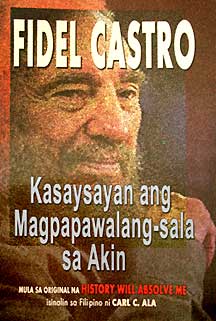
MAKING IT HIT CLOSER TO HOME
Kasaysayan ang Magpapawalang-sala sa Akin
Filipino translation of Fidel Castro’s History will Absolve Me by Carl C. Ala
Published by AMISTAD
63 pages

2006 carries a double significance for AMISTAD. Aside from marking the 80th birthday of Cuban president Fidel Castro, it is also the 60th year of diplomatic relations between the Philippines and Cuba. AMISTAD chose to celebrate what its president George Aseniero calls “milestones” by publishing Kasaysayan ang Magpapawalang-sala sa Akin, a Filipino translation of Cuban President Fidel Castro's famous five-hour speech History will Absolve Me by Carl C. Ala.

BY ALEXANDER MARTIN REMOLLINO

Bulatlat


2006 carries a double significance for AMISTAD, a solidarity organization aiming to forge and promote friendship, unity, understanding, and solid relations between the Filipino and Cuban peoples. Aside from marking the 80th birthday of Cuban President Fidel Castro, it is also the 60th year of diplomatic relations between the Philippines and Cuba.

AMISTAD chose to celebrate what its president George Aseniero calls “milestones” by publishing Kasaysayan ang Magpapawalang-sala sa Akin, a Filipino translation of Castro's famous five-hour speech History will Absolve Me by Carl C. Ala.

Delivered in 1953, History will Absolve Me was Castro’s piece in his own defense as he stood on trial for the botched siege on Moncada Barracks.

Ala's achievement in translating Castro’s speech lies in his being able to give it a tinge of greater familiarity within the Philippine context.

The attack on Moncada Barracks was intended as the culmination of the uprising by the Castro-led revolutionary forces against the U.S.-sponsored dictatorship of Fulgencio Batista, which had wrested power through a coup backed by the Central Intelligence Agency (CIA) the previous year.

The uprising that is the subject of Castro’s speech aimed at seizing Moncada Barracks without bloodshed. The revolutionary forces had no plans of shooting it out with the soldiers at the barracks. What they intended was to seize the arms and ammunition through a surprise attack and peacefully convince the soldiers to abandon the dictatorship.

After seizing power, the revolutionaries would have enacted five revolutionary laws that would declare the legitimacy of Cuba’s 1940 Constitution and effect industrialization, land distribution, and reforms in foreign relations, education, housing, and labor and industrial relations. These were the same objectives that the Castro-led revolutionary forces went on to attain after finally succeeding in toppling the Batista dictatorship in 1959.

The 1953 siege on Moncada Barracks was botched because the revolutionaries were vastly outnumbered and were traversing unfamiliar territory. Castro and his companions were arrested and many were tortured and summarily executed. Those who survived, like Castro himself, faced rebellion charges.

In his speech Castro, a lawyer who had opted to defend himself in court, questions the legitimacy and even legality of the Batista regime:

Saang bansa ba nakatira ang Kagalang-galang na (Tagausig)? Sinong nagsabi sa kanya na nais naming mag-aklas laban sa konstitusyunal na kapangyarihan ng Estado? Dalawang bagay ang malinaw. Una sa lahat, ang diktadura na umaapivsa bansa ay hindi isang konstitusyunal na kapangyarihan, ito ay hindi konstitusyunal. Ito ay itinatag laban sa Konstitusyon, kshit na may Konstitusyon at lumalabag sa Konstitusyon ng lehitimong Republika. Ang lehitimong Konstitusyon ay direktang nakaugat sa soberanya ng mamamayan. Patutunayan ko ang puntong ito (nang) buo mamaya, kahit may mga panlolokong gawin ang mga duwag at traydor upang bigyang-matwid ang di makatarungan. Pangalawa, ang tinutukoy ng artikulo ay hinggil sa kapangyarihan na pangmaramihan at hindi pang-isahan. Dahil isinasaalang-alang nito ang kalagayan na ang Republika ay pinamumunuan ng lehislatibong kapangyarihan, ehekutibong kapangyarihan, at hudisyal na kapangyarihan na nagbabalanse at (nagkokontrabalanse). Na (inagaw) at pinag-isa ang lehislatibo at ehekutibong kapangyarihan ng bansa, na siyang nagwasak sa buong sistemang pinagbabatayan ng artikulo sa Kodigo na ating sinusuri, na siyang dapat nitong pangalagaan. Ni hindi ko na babanggitin ang kasarinlan ng hudisyal na kapangyarihan matapos ang Marso 10 dahil ayokong magbiro ... kahit anong paghatak, pagpapaikli o pagkumpuni sa Artikulo 148, hindi ito aangkop sa mga pangyayari noong Hulyo 26. Iwan muna natin ito hanggang lumitaw ang oportunidad na maaari itong gamitin laban sa mga talagang nagsulong ng pag-aalsa laban sa konstitusyunal na kapangyarihan ng Estado.

(In what country is the Honorable Prosecutor living? Who has told him that we have sought to bring about an uprising against the Constitutional Powers of the State? Two things are self-evident. First of all, the dictatorship that oppresses the nation is not a constitutional power, but an unconstitutional one: it was established against the Constitution, over the head of the Constitution, violating the legitimate Constitution of the Republic. The legitimate Constitution is that which emanates directly from a sovereign people. I shall demonstrate this point fully later on, notwithstanding all the subterfuges contrived by cowards and traitors to justify the unjustifiable. Secondly, the article refers to Powers, in the plural, as in the case of a republic governed by a Legislative Power, an Executive Power, and a Judicial Power which balance and counterbalance one another. We have fomented a rebellion against one single power, an illegal one, which has usurped and merged into a single whole both the Legislative and Executive Powers of the nation, and so has destroyed the entire system that was specifically safeguarded by the Code now under our analysis. As to the independence of the Judiciary after the 10th of March, I shall not allude to that for I am in no mood for joking ... No matter how Article 148 may be stretched, shrunk or amended, not a single comma applies to the events of July 26th. Let us leave this statute alone and await the opportunity to apply it to those who really did foment an uprising against the Constitutional Powers of the State. Later I shall come back to the Code to refresh the Honorable Prosecutor's memory about certain circumstances he has unfortunately overlooked.)


Translated into Filipino, this paragraph in large part bears similarities with what is happening in the Philippines today. There is something particularly in the reference to an “unconstitutional” dictatorship "that oppresses the people" that sounds extremely familiar. The paragraph could very well have been lifted from a testimony by any of the opposition leaders –- whether Left or traditional –- who were cracked down upon in the wake of the foiled Feb. 24 attempt at withdrawal of support by soldiers led by Brig. Gen. Danilo Lim.

Castro goes on to elaborate on the siege itself: How it was done, why it was done in the manner that it was, and what the revolutionaries sought to accomplish had they succeeded. This is all summed up in the following paragraph:

Kaya ng (Cuba na) pangalagaan ang populasyong tatlong beses ang laki kaysa sa ngayon. Walang dahilan para sa kahirapang nararanasan ng kasalukuyang naninirahan dito. Ang mga palengke ay dapat na umaapaw sa mga produkto, ang nga eskaparate ay dapat na puno, ang lahat ay dapat na may trabaho. Ito ay hindi pangarap lang. Ang di kapanipaniwala ay may mga taong natutulog (nang) gutom, samantalang may masasakang lupa, ang mga bata ay namamatay dahil sa kakulangan sa medikal na pagkalinga; ang di kapanipaniwala ay 30% ng mga magbubukid ay di man lamang kayang isulat ang kanilang pangalan at 99% sa kanila ay walang alam sa kasaysayan ng Cuba. Ang di kapanipaniwala ay kalakhan ng mga pamilya ng mga magbubukid ay nabubuhay sa mas masahol na kalagayan kaysa sa mga Indian na natagpuan ni Columbus sa pinakamagandang lupa na nakita ng tao.

(Cuba could easily provide for a population three times as great as it has now, so there is no excuse for the abject poverty of a single one of its present inhabitants. The markets should be overflowing with produce, pantries should be full, all hands should be working. This is not an inconceivable thought. What is inconceivable is that anyone should go to bed hungry while there is a single inch of unproductive land; that children should die for lack of medical attention; what is inconceivable is that 30% of our farm people cannot write their names and that 99% of them know nothing of Cuba's history. What is inconceivable is that the majority of our rural people are now living in worse circumstances than the Indians Columbus discovered in the fairest land that human eyes had ever seen.)


Again, an eloquent passage that, when translated into Filipino, could have been an indictment –- if not condemnation –- of the Philippines’ own wretched conditions, were it not for the direct references to Cuba and to statistics particular to the Cuban experience.

Ala’s shortcomings in the way this book was done lie chiefly in his having fallen prey to the grammatical errors most commonly committed by non-native speakers of Tagalog, on which Filipino is largely based -- as can be found, for example, in his frequent interchanging of "nang" and "ng." There are also some parts where his translation gets too literal, as in his having translated “edible oil” as "nakakaing langis" –- a phrase that is absent from the Filipino lexicon – when he could have easily used "mantika." There are a few hyphens where there should be none, as in "Taga-usig" which should be written as "Tagausig."

These shortcomings, which could easily be corrected for the next printing, are however small compared to his success in translating the most important parts. By and large Ala’s main achievement in this translation is in making a 1953 Cuban speech hit closer to home for today's Filipino readers.

Ala is an alumnus of the University of the Philippines (UP) in Manila, where he was an active member of the National Network of Agrarian Reform Advocates (NNARA) Youth. He is now the public information officer of the Kilusang Magbubukid ng Pilipinas (KMP or Philippine Peasant Movement). Bulatlat

Wednesday, December 06, 2006

HE DIDN'T SAY WHY HIS BLOOD WAS WANTED
Alexander Martin Remollino

"The people wanted the blood of a young man, and that's what swayed the decision."

--- L/Cpl. Daniel Smith, on Makati RTC Judge Benjamin Pozon's decision convicting him of the rape of "Nicole" in Subic, Zambales last year


Of course he didn't say why his blood was wanted,
and that has made us look
like a big bunch of bloodsuckers.
Lest it be erased from the pages of the mind,
it has to be said again:
his blood was wanted because the dirt
with which he and three others smeared the honor
of a young woman and an entire nation
cried out to the ends of the earth
for his blood to cleanse it.

Of course it was a derogatory remark.
But in deprecating us,
he complimented us.
He acknowledged with his insult to the nation
that there's still a sense of justice in this land.
His calumny was a tribute.

Tuesday, December 05, 2006

MILITANTS ON SUBIC RAPE VERDICT:
'IT FALLS SHORT'


BY ALEXANDER MARTIN REMOLLINO
Bulatlat
Posted 6:25 p.m., Dec. 4, 2006

The victory is only partial, as the decision falls short of what the verdict should have been.

This was how the leaders of the militant groups that rallied outside the Makati Regional Trial Court today described Judge Benjamin Pozon’s decision on the Subic rape case.

Pozon found the principal accused Lance Cpl. Daniel Smith guilty of raping “Nicole,” the court-assigned name of the Subic rape victim, on Nov. 1 last year. His co-accused S/Sgt. Chad Carpentier, Lance Cpl. Keith Silkwood, and Lance Cpl. Dominic Duplantis were acquitted.

“We could have been happy that at least one was convicted,” said Bagong Alyansang Makabayan (Bayan or New Patriotic Alliance) secretary-general Renato Reyes, Jr. “But this only showed our limited ability to prosecute offending U.S. soldiers for as long as we have the Visiting Forces Agreement (VFA).”

“For as long as we have difficulty getting custody of offending U.S. soldiers, it becomes harder to file and pursue charges against them, it becomes harder to haul them to prison,” Reyes added.

The VFA, which was ratified in 1999 by the Senate and grants extraterritorial and extrajudicial privileges to U.S. troops visiting the country for joint military “exercises” with the Armed Forces of the Philippines (AFP), provides that Philippine authorities shall waive their primary right to exercise jurisdiction upon request by U.S. authorities, except in cases the government considers to be of particular importance to the Philippines.

“We feel a limited satisfaction (with the decision), as there was one who was found guilty,” said Gert Ranjo-Libang, spokesperson of the women’s group GABRIELA. “But it’s limited, because the three others were not found guilty as charged. We think all four of them should have been convicted.”

“We are also demanding the abrogation of the VFA,” she added. “Because under this agreement, even if Smith was found guilty, there is a question on where he is to be jailed. Under the VFA, the Philippine and U.S. governments still have to confer on where the guilty party is to be jailed.”

Reyes expressed a similar view. “That is what is sad about the whole thing: whatever will be agreed about with the U.S. will depend on the political will of the Arroyo administration, and that is not the justice that we want,” the Bayan leader said.

Meanwhile, former Vice President Teofisto Guingona, Jr., a noted nationalist, hailed the decision as a “partial victory,” but stressed that the Philippines should have custody of Smith as the crime of rape, he said, “is of particular importance” to the Philippines.

“There are imbalances that should be corrected,” Guingona said when asked how he expected the decision to affect RP-U.S. relations. “The sovereignty should belong to the Philippines in crimes of particular importance.”

Pozon also decided that Smith should be temporarily detained at the Makati City Jail. However, as of 4 p.m. –- more than an hour after the verdict was promulgated –- Smith had not been brought to the said detention facility. Bulatlat

Monday, December 04, 2006

SA PILIPINAS LANG YATA
Alexander Martin Remollino

Dito lang yata sa Pilipinas maaaring mangyaring kapag ang isang mamamayan ng bansa ay ginahasa ng ilang sundalong Amerikano ay ang mga opisyal pa ng pamahalaan ang kauna-unahang magbubuhos ng asin sa kanyang sugat.

Nakita natin ito sa kaso ng dalagang tinatawag ngayon ng “Nicole,” na ginahasa ng ilang sundalong Amerikano noong Nobyembre 1, 2005 sa Subic, Zambales. Sa usaping ito’y walang kahiya-hiyang ipinamalas ng matataas na opisyal ng ating pamahalaan ang pagiging “gulugod-dikya,” sa wika nga ng manunulat na si Rogelio L. Ordoñez, sa harap ni Tiyo Samuel.

Mula nang pumutok ang balita hinggil sa panggagahasa kay “Nicole” walang isang linggo matapos ang insidente hanggang sa mga araw na ito, wala tayong naririnig na anuman mula sa Pangulong Arroyo hinggil sa bagay na ito.

Kahit sa Hapon, na bagama’t nakalaban ng Estados Unidos noong Ikalawang Digmaang Daigdig ay napakalaki ng ipinakinabang sa Marshall Plan — na ang ibinunga’y ang pagiging higante ngayon ng mga korporasyong Hapones sa pandaigdigang ekonomiya, ilang dekada matapos na malumpo ang kanyang ekonomiya — ay hindi nangyayari ang ganitong mga kasalarinan nang walang naririnig na matitinding pananalita mula sa punong ministro, kundi man sa mismong emperador.

Ang nagsalita para sa Pangulong Arroyo hinggil sa usaping ito ay si Sekretaryo Ignacio Bunye, tambulero ng Malacañang, na ang sabi’y “huwag gawing pulitikal” ang naturang pangyayari. Ito lamang ang sinabi ni Bunye — na nanguna pa naman sa klase nang magtapos sa Muntinlupa High School maraming taon na ang nakalilipas — hinggil sa isyung ito, at wala nang iba pa.

Ni kapirasong dura man lamang na magtatangkang ipaliwanag kung paano hindi magiging pulitikal ang isang kaganapang nakukulayan ng di-patas na ugnayan ng Pilipinas at Estados Unidos ay wala tayong narinig mula sa mahusay na kalihim sa pakikipag-ugnayan sa pabatirang-madla.

Kung ano ang katahimikan ng Pangulong Arroyo hinggil sa pangyayaring ito ay gayundin ang katahimikan tungkol dito ng noo’y pinuno ng Hukbong Sandatahan ng Pilipinas na si Hen. Generoso Senga, at ng ngayo’y namumuno ritong si Hen. Hermogenes Esperon — na kayhusay pa namang magmalaking naging “aktibista” siya bago pumasok sa militar. Gayundin ang naging pananahimik ukol dito ni dating Sekretaryo Avelino Cruz ng Kagawaran ng Tanggulang Pambansa.

Si Sekretaryo Raul Gonzalez ang salita nang salita kaugnay nito, ngunit sa bawat buka ng kanyang bibig at ito ang napag-uusapan ay wala naman tayong marinig kundi ang tunog ng bunganga ng isang abugado para sa Estados Unidos.

Noon pa mang una’y pakawala na nang pakawala si Gonzalez ng mga pahayag na nagpapahiwatig na hindi siya naniniwalang ginahasa nga si “Nicole.” Ito’y kahit may malakas na ebidensiyang nagpapatunay na siya nga’y ginahasa.

Nang sina Carpentier, Silkwood, at Duplantis ay maisakdal bilang mga pangunahing akusado kasama ni Smith, nagwika pa itong kagalang-galang na Sekretaryo Gonzalez na dapat sana’y higit na mababa ang sakdal sa tatlo, subalit siya raw ay yumukod upang “papayapain ang nagwawalang madla” — kahit pa may sapat na batayang ligal upang ituring silang pangunahin ding akusado.

Samantala, niluwagan nang husto ng pangkat ng mga tagausig na itinalaga ng gobyerno — sa pamumuno ni Senior State Prosecutor Emilie de los Santos at, ayon sa ina ni “Nicole” at sa kanilang pribadong abugadang si Evalyn Ursua, liban kay State Prosecutor Hazel Valdez — ang pagtatanong sa mga nasasakdal na sina Lance Cpl. Daniel Smith, S/Sgt. Chad Carpentier, Lance Cpl. Keith Silkwood, at Lance Cpl. Dominic Duplantis. Dahil dito, nahirapan ang kampo ni “Nicole” na basagin ang palusot ng depensa na si “Nicole” diumano’y kusang nagpagalaw kina Smith.

Nang sa isang bahagi ng paglilitis ay waring nakalamang sina Smith, muli sanang isasalang si “Nicole” upang makapagharap ng rebuttal evidence, ngunit ang hakbang na ito’y kinansela ni De los Santos, ayon kay Valdez. Sa magiting na pagbubunyag na ito, gantimpala ni Gonzalez kay Valdez ang pagtatanggal sa kanya mula sa lupon ng mga tagausig.

Dapat silang mahiya roon sa gobernador ng Okinawa na noong dekada 1990, nang gahasain doon ng isang sundalong Amerikano ang isang lalabindalawahing taong gulang na babae, ay nanguna pa sa pananawagan ng mga higanteng kilos-protesta.

Tunay na isang malaking kahihiyan sa ganang atin ang tayo’y madaig ng Hapon sa ganitong mga bagay. Bagama’t matapos ang Ikalawang Digmaang Pandaigdig — kung saan napilay ang kanyang ekonomiya — ay malaki ang ipinakinabang niya sa ayuda ng Estados Unidos, hindi pa rin siya nangiming panindigan ang dapat panindigan.

Malayo roon ang Pilipinas. Kayrami nating kababayang nagbuhos ng dugo noong Ikalawang Digmaang Pandaigdig alang-alang sa “alyansang Pilipino-Amerikano” at ngayon, ilang dekada na ang nakararaan matapos ang giyera, ay wala tayong nakikita ni anino ng kagaya ng Marshall Plan, at sa halip ay natali pa nga tayo sa isang bungkos ng mga kasunduang hindi makatarungan. Sa kabila nito, ang ating pamahalaan ay pangunahing pandaigdigang tanghalan ng pamamanginoon kay Tiyo Samuel — sa ngalan ng isang katawa-tawang “natatanging ugnayan.”

Dito lang yata sa Pilipinas maaaring masaksihan ang ganitong antas ng pangangayupapa ng mga opisyal ng pamahalaan sa mga dayuhan at lalo na’y sa mga Amerikano.

Sunday, December 03, 2006

ON EVE OF DECISION ON SUBIC RAPE CASE:
JUSTICE IS ABOVE 'SPECIAL RELATIONS,' WOMEN'S GROUP SAYS


BY ALEXANDER MARTIN REMOLLINO
Bulatlat
Posted 8:55 p.m., Dec. 3, 2006

“Ensuring justice for our aggrieved fellow Filipino should come first before what President Gloria Macapagal-Arroyo perceives as good relations between the Philippines and the U.S.”

This was what Joan Salvador, chairperson of GABRIELA Youth, told reporters on the eve of the promulgation of the verdict on the Subic rape case. Salvador was the main speaker in a brief rally and candle-lighting activity held by members of the women’s group GABRIELA early evening today at the Boy Scouts’ Circle along Timog Avenue, Quezon City.

The GABRIELA members mounted candles on the sidewalk, arranged to form the word JUSTICE. “Jail the rapists!” they chanted as they brandished placards calling for justice for “Nicole,” the court-assigned name of the Subic rape victim.

“Nicole,” the daughter of a prominent family from Zamboanga, was raped allegedly by four U.S. Marines on Nov. 1 in Subic, Zambales last year. Her case is expected to bear implications for RP-U.S. relations as it is said to be the first against U.S. soldiers to be brought to any Philippine court.

Judge Benjamin Pozon of the Makati Regional Trial Court, Branch 139 is set to promulgate the verdict on the case of “Nicole” tomorrow afternoon –- a week after the original schedule he had committed. GABRIELA will be joined by other groups under the banner of the Bagong Alyansang Makabayan (Bayan or New Patriotic Alliance) tomorrow in a rally in front of the Makati RTC.

Salvador also chided the Arroyo government for not asserting custody of the principal accused Lance Cpl. Daniel Smith and accomplices S/Sgt. Chad Carpentier, Lance Cpl. Keith Silkwood, and Lance Cpl. Dominic Duplantis –- as she said it could have done.

“The Philippines made accommodations and compromises favoring America,” Salvador said. “We have seen how the government, especially Gloria, shied away from asserting the dignity and rights of our fellow Filipino and showed more concern over protecting the relations between the Philippines and the U.S.”

“Our assertion is whatever happens, justice should come first,” Salvador added. Bulatlat
ANTI-CRIME GROUP CALLS FOR ARMY PULLOUT FROM BICOL
BICOL PEASANT 'AUTOPSIED ALIVE,' SHOT DEAD


The Volunteers Against Crime and Corruption (VACC) has called for a “complete pullout” of Army troops from the Bicol Region amid what he described as “the alarming number of tortures and extrajudicial killings” in the area. This call comes in the wake of the torture and killing of a Bicol peasant accused by his Army captors of being a member of the New People's Army (NPA).

BY ALEXANDER MARTIN REMOLLINO
Bulatlat

The Volunteers Against Crime and Corruption (VACC) has called for a “complete pullout” of Army troops from the Bicol Region amid what it described as “the alarming number of tortures and extrajudicial killings” in the area.

Dante Jimenez, who hails from the Bicol Region, said this in an interview with Bulatlat last week. “Instead of winning the hearts and minds of the people, they are the problem,” the VACC leader said of the Army troops in the Bicol Region.

His call comes in the wake of the torture and killing of Toribio Mesa, a Bicolano peasant accused by his Army captors of being a member of the New People’s Army (NPA).

The VACC leader said Mesa's case had been reported to the VACC’s office. He also told Bulatlat that one of Mesa's children is a former student of his.

In a Nov. 23 letter to Armed Forces of the Philippines (AFP) chief of staff Gen. Hermogenes Esperon, of which Bulatlat was given a copy, Jimenez narrated the details behind the case of Mesa, a resident of Jamorawon village, Bulan, Sorsogon. Wrote Jimenez:

Mesa died while in the custody of the 92nd Recon Company, 9th Infantry Division of the Philippine Army, under extremely dubious circumstances last Nov. 16, 2006.

The said Mesa –- father of 13, had been forcibly taken from his family without warrant of arrest, and his home was arrogantly searched without any valid search warrant on Nov. 15, 2006. The following day subject was declared dead and found sustaining two gunshot wounds and deep cuts on his left arm.


“We found that extremely suspicious, so we requested Sorsogon and Bulan police to re-autopsy the victim’s body,” Jimenez told Bulatlat. “It turned out his captors had performed a live autopsy on his arm and then they shot him.”

“We are calling for the complete pullout and replacement of the Army in the Bicol Region because of the alarming number of tortures and extrajudicial killings there,” the VACC leader also said.

In his letter to Esperon, Jimenez said the VACC calls for the “immediate relief” of the unit's commanding officer, as well as the preventive suspension of Pfc. Warren Mangubat and Pfc. Jonathan Ongog pending investigation of the case.

“We suggest that the Philippine Army be replaced by the Philippine Marines of the Navy, or Philippine Air Force until such time that Army soldiers in the region learn the basic knowledge of due process, rule of law and above all, respect for human rights,” Jimenez wrote to Esperon.

Not the first time

This is not the first time that Army soldiers have been directly identified as perpetrators of extrajudicial killings in the Bicol Region.

On May 7, 2004, Mylene and Raymond Golloso –- then 13 and 6 years old, respectively -- were killed by armed men within the sanctity of their own home in Brgy. Recto, Bulan, Sorsogon.

Mylene and Raymond, together with brother Resty, had hid in their parents’ bedroom upon hearing gunshots near their house that day. In the end that failed to protect them: they were later found dead, their heads shattered by gunshots.

In a written and signed statement, a copy of which was received by Bulatlat, 11 officials and 42 other residents of Brgy. Recto said no other armed group was in the village that day except seven soldiers from the 2nd Infantry Battalion, 901st Infantry Brigade of the 9th Infantry Division; and two members of the paramilitary Citizen Armed Forces Geographical Unit (CAFGU). The Brgy. Recto officials and residents specifically identified among them Cesar Luares, a CAFGU member.

Adelia, Mylene and Raymond’s mother, identified Luares in a sworn statement as a native of Bulan. Bulatlat received a copy of her sworn statement.

Army soldiers were likewise positively identified by no less than the municipal police of Daraga, Albay as the perpetrators of the killing of Methodist Pastor Isaias Sta. Rosa last Aug. 3.

Based on sworn statements and affidavits by Sta. Rosa's wife Sonia, his brothers Jonathan and Ray Sun, and neighbor Alwin Mirabona, a number of hooded armed men barged into the house of Jonathan and Ray Sun, at around 7:30 p.m. that night, and took them hostage.

After a few minutes, Jonathan was dragged at gunpoint to Isaias’ house nearby, where the pastor was watching videos on a laptop computer with his daughter. Jonathan was brought to a room together with Sonia and her children, while Isaias was dragged into another room and beaten up. A few minutes later, they saw the armed men dragging Isaias out. Sonia called for help from her sister Madelyn, who lived nearby. Madelyn roused the neighbors with her cries for help.

After a while, nine gunshots were heard nearby. Isaias’ corpse was found about 50 meters from his house, beside one of the assailants.

A responding team from the Daraga Municipal Police Office recovered from the hooded man's body an ID card revealing him to be Cpl. Lordger Pastrana; as well as a mission order issued to the ID card bearer by the 9th Military Intelligence Battalion of the 9th Infantry Division, authorizing him to carry a firearm outside the headquarters. The mission order – of which Bulatlat received a copy – was issued by Maj. Ernest Rosal, commanding officer of Pastrana’s unit, which is based in Pili, Camarines Sur, and referred to a “secret mission” with duration from July 1 to Sept. 30, 2006.

A news item from the Philippine Information Agency (PIA) and data from military sources show that the 9th Infantry Division has been under the command of Maj. Gen. Ricardo Nobleza since December 2004.

Killings in Bicol

Based on data from Karapatan (Alliance for the Advancement of People’s Rights), there have been 797 victims of extrajudicial killings from January 2001 –- when Arroyo was catapulted to power through a popular uprising –- to November 2006. Of this number, at least 340 are confirmed to have been affiliated with cause-oriented groups.

The total number of extrajudicial killings for this year alone, Karapatan data further show, is 185. Of these, 53 were perpetrated in Central Luzon, 30 in the Bicol Region, and 20 in Southern Tagalog –- making these the top three regions in terms of the number of extrajudicial killings.

Last June, Arroyo declared “all-out war” against the Left and directed the AFP to finish off the “communist insurgency” in two years. Arroyo named Central Luzon, the Bicol Region, and Southern Tagalog as “priority areas” in her directive to the AFP.

“Perhaps there is a plan, or it’s part of the strategy,” Jimenez said when asked whether he thought there was any connection. “But you cannot win the hearts and minds of the people that way.”

“It’s worse than the death penalty because in the death penalty, they follow due process,” added the VACC leader, a known capital punishment proponent. “In extrajudicial killings there is no due process, that’s why they are called extrajudicial killings.” Bulatlat