Sunday, November 12, 2006

ONE OF BICOL PASTOR'S KILLERS HAD ARMY MISSION ORDER

Army Pfc. Lordger Pastrana, the leader of a group of hooded armed men who tortured and killed Methodist Pastor Isaias Sta. Rosa in Daraga, Albay on the fateful night of Aug. 5 this year was a soldier who had a mission order authorizing him to carry a firearm outside the headquarters. The case of Sta. Rosa is one of those to be presented before the Permanent Peoples’ Tribunal (PPT) next year.

BY ALEXANDER MARTIN REMOLLINO
Bulatlat
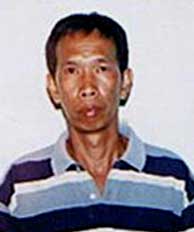


Army Pfc. Lordger Pastrana, the leader of a group of hooded armed men who tortured and killed Methodist Pastor Isaias Sta. Rosa in Daraga, Albay on the fateful night of Aug. 3 this year was a soldier who had a mission order authorizing him to carry a firearm outside the headquarters.

A copy of the mission order was obtained by the Daraga local police in the course of its investigation into the killing. The mission order and the name of Pastrana were recently mentioned in a report by the human rights alliance Karapatan and also reported by a major daily.

Sta. Rosa is one of 780 victims of extra-judicial killings, as of Nov. 11, under the Arroyo administration. His case is one of many to be presented before the Permanent Peoples’ Tribunal (PPT) in Den Haag, The Netherlands, where President Gloria Macapagal-Arroyo is to be tried for violations of the Filipino people’s individual and collective rights, next year.

Based on sworn statements and affidavits by Sta. Rosa’s wife Sonia, the victim’s brothers Jonathan and Ray-Sun, and neighbor Alwin Mirabona, at around 7:30 p.m. that night, three hooded armed men barged into the house of Jonathan and Ray Sun.

The men – two of whom were wearing camouflage pants, combat boots, and dark long-sleeved shirts – were looking for Isaias. They ordered the two brothers to lie on the ground, and then stepped on their heads and pointed guns at them. From his position, Ray Sun was able to observe more hooded armed men positioned amid the bushes. Jonathan tried to look around and was hit with a gun barrel in the head.

Jonathan and Ray Sun were both accused of being members of the New People’s Army (NPA), which they both denied. They were stripped of their shirts to see if they were armed. Jonathan was then dragged at gunpoint to Isaias’ house a few meters away.

In her affidavit, Sonia said that she and her son Philip were watching TV while Isaias and their daughter April Handem (“Dem-dem”) were watching videos on a laptop computer.

Habang nagkukuwentuhan sila, biglang may kumatok sa pintuan ng bahay namin at narinig namin ang ‘Manoy...’ (tawag sa Bikolano sa nakatatandang kapatid na lalaki). Pagsilip ko sa pinto, nakita ko si Jonathan (‘Owie’), bunsong kapatid ni Pastor. Wala siyang damit pang-itaas at parang maysakit ang hitsura. Kaya tinawag ko ang aking asawa. Pagsilip naming mag-asawa, bigla at mabilis na pumasok sa bahay namin ang humigit-kumulang sampung armadong kalalakihan na lahat ay nakabonet, tinutukan kami ng mga baril at pinadapa kaming lahat” (As they were talking, someone suddenly knocked on the door and we heard someone calling “Manoy...” [Bicolano term for elder brother]. When I peeped through, I saw Jonathan naked from the waist up and looking in pain. So I called my husband. When we peeped through, more or less ten armed and hooded men suddenly and barged into our house, pointed their guns at us and told us to drop to the floor), Sonia said.

The men, Sonia said, were all wearing black sweatshirts, camouflage pants, and combat shoes – except for the one commanding them, whom she described as wearing a maroon polo shirt, a vest, black shorts, and black rubber shoes.

Isaias’ hands were tied with a nylon cord behind him. In Sonia and Jonathan’s affidavits and sworn statements, they told of Isaias being beaten up as he was forced to admit he was the “Elmer” they were looking for.

Jonathan, Sonia and her three children Dem-dem, Philip and Mikko were brought to a room while Isaias was taken to another. They could hear the soldiers continuing to beat Isaias up, said Sonia and Jonathan. Ray Sun was then brought into the room where Sonia, Jonathan, and the children were.

A few minutes after, the soldiers went out of the house bringing with them the bloodied and still tied-up Isaias, as well as the laptop computer and the mobile phones of the pastor and Mikko.

Sonia ran out and cried for help from her sister Madelyn, who lived nearby. Madelyn roused the neighbors with her cries for help.

From a distance, six shots were heard, and then a pause, and then another three shots. Ray Sun, Jonathan, and the neighbors ran in the direction of the gunshots.

They found Isaias’ bullet-riddled body about 50 meters away from his house. Beside his body was that of a hooded man wearing a maroon shirt, black short pants, and black rubber shoes, as well as a .45 pistol fitted with a silencer.

After a few more minutes, a group of policemen led by Supt. Jose Capinpin, Daraga police chief; and barangay (village) captain Artita Padilla arrived.

They recovered from the scene the pistol, a spent shell from a .45 caliber pistol, and a .45 caliber slug.

From the corpse of the hooded man they recovered a Philippine Army identification card of one Pfc. Lordger Pastrana and a mission order issued to the ID card bearer by the 9th Military Intelligence Battalion of the Philippine Army’s 9th Infantry Division, based in Camp Weene Martillana in Pili, Camarines Sur. The mission order was signed by Maj. Ernest Rosal and refers to a “secret mission” valid July 1 to Sept. 30, 2006.

A photocopy of the mission order was received by Bulatlat courtesy of the Public Interest Law Center (PILC), whose lawyers Rachel Pastores and Amylyn Sato are part of the prosecution panel that will face the PPT next year.

Based on a news item from the Philippine Information Agency (PIA), the 9th Infantry Division – which has headquarters at Camp Elias Angeles in Pili – has been under the command of Maj. Gen. Ricardo Nobleza since December 2004.

However, Daraga police investigators ruled that the case was one of robbery with homicide. “Based on the foregoing facts, evidence at hand and sworn statements of the witnesses Cpl. Lordger Pastrana was among the group who abducted and killed Isaias Sta. Rosa and also the robbery hold up (sic) of Alwin Mirabona, Ray Sun Sta. Rosa and Jonathan Sta. Rosa all of Malobago, Daraga, Albay,” wrote SPO1 Alex Moral of the Daraga police in an investigation report dated Aug. 21.

Subsequent investigations by the Commission on Human Rights (CHR) in Region V and a fact-finding team formed by the United Methodist Church (UMC) affirmed that the group led by Pastrana was responsible for the killing of Sta. Rosa.

The findings from both investigations, however, were that there was more to the killing than a mere robbery with homicide. Bulatlat
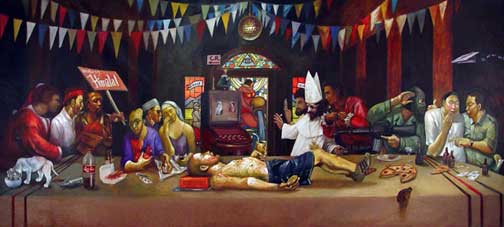
PUBLIKHAAN: MAKING HUMAN RIGHTS ISSUES PUBLIC

Tutok Karapatan (TutoK), a group of artists advocating human rights, will hold a series of upcoming art events starting this month, tackling the spate of extra-judicial killings in the Philippines. TutoK was formed late last year as a response to what the group described as the “deteriorating” human rights situation in the country.


BY ALEXANDER MARTIN REMOLLINO
Bulatlat


Performance artist Jeho Bitancor came out of a room dressed in dark glasses, slacks and a long-sleeved shirt with necktie. Threatening to burst out from under his shirt, making him look like a heavy-built underworld ninong (godfather), were various objects he had stuffed under it.

He stood by a table and took out from under his shirt a loaf of bread. He next took out a glass object that looked like the top of a cathedral’s steeple. He inverted the glass object and inserted the cross into the bread. He then filled the part of the glass object sticking out with cream. He sipped some and then spit it out, letting it drip over his necktie and shirt.

He took out three apples from under his shirt, and then a plastic doll resembling a baby. With a hammer he also took out from under his shirt, he bored a hole into the doll’s abdomen, stuffed the apples into it, and then crushed them with the hammer. The doll now looked like a bloated and disemboweled corpse of an infant.

He placed the doll into a plastic bag which he hanged with a string from his neck.

Attached to the string was a tag on one side of which read “kapayapaan” (peace), and on the other side read “demokrasya” (democracy).

Bitancor’s performance was the finale in a press conference held by Tutok Karapatan (TutoK) last Nov. 7 at the Newsdesk Cafe in Quezon City. TutoK held the press conference to announce a series of art events tackling human rights starting this month to April next year.

TutoK was formed late last year as a response to what the group described as the “deteriorating” human rights situation in the country.

Based on data from Karapatan (Alliance for the Advancement of People’s Rights), there have been 780 victims of extra-judicial killings under the Arroyo regime from January 2001 to Nov. 11, 2006. Of this number, 339 are with known political affiliations.

The idea for TutoK came up in November last year during a workshop among artists on women, art and healing at Sambalikhaan, Quezon City. In an open forum held after a discussion on the human rights situation in the country, a number of the participants talked about a plan to pay tribute to the victims of extra-judicial killings through a series of portraits.

Artists’ initiative


“This is an artists’ initiative,” explained TutoK project director Karen Ocampo-Flores, a painter, during the press conference. “The art events are to be financed mainly with our group’s own funds, which we raised by selling artworks last year.”

Painters Emmanuel Garibay and Jose Tence Ruiz are the group’s chairman and adviser, respectively.

Other members of the group’s steering committee aside from Flores are: Ruel Caasi, Mideo Cruz, Noel Cuizon, Boy Dominguez, Racquel de Loyola, Cap Reyes, Raoul “Iggy” Rodriguez, Wire Tuazon, Ramon “Chitoy” Zapata, Mike Muñoz, Noell El Farol, Ferdie Montemayor, Alfredo Juan Aquilizan, writers Lisa Ito and Richard Gappi, and Arlene Brosas of the Musicians for Peace.

The first event to be held by TutoK for this year is Publikhaan: Making Human Rights Issues Public, a partnership with the Neo-Angono Artists Collective which spearheads the activity. In this event, TutoK integrates with the third Neo-Angono Public Art Festival, to be held Nov. 16-22.

Participating groups in Publikhaan are Kaktus, Linangan ng Imahen, Retorika at Anyo (LIRA), Kalipunan ng Sining at Kultura ng Pasig, Kilometer 64, New World Disorder, Ugatlahi, Komikera, Anino Shadowplay Collective, Sto. Niño Choir, Surrounded by Water, Ideas, Tandang Juancho Museum and the University of Rizal System.

The next event would be Perspektiba, a series of exhibits on the political killings. Curated by Cruz, it will open at the Beato Angelico Gallery, University of Santo Tomas (UST) on Nov. 21 with a live installation by Bitancor. The exhibit will run at UST until Dec. 2. As part of the Perspektiba-UST event, TutoK will hold a forum in the afternoon on Nov. 29, with multi-awarded novelist Jun Cruz Reyes as the main speaker. At night that same day, there will be performances by artists Jose Tence Ruiz, Jef Carnay, and Cos Zicarelli; and award-winning poets Roberto Ofanda Umil and Angelo Suarez.

Other participating artists in the Perspektiba-UST exhibit are painters Antipas Delotavo, Boy Dominguez, Gene de Loyola, and Manny Garibay; multi media artist Claro Ramirez, Lyra Garcellanno, Don Salubayba, Ed Manalo, Benjo Elayda, Mark Ramsel Salvatus III and Buen Calubayan; and art groups Anting anting and UGATLahi.

The Perspektiba series of exhibits will next run at St. Scholastica’s College in January next year, and at the University of the Philippines (UP) in Diliman, Quezon City in February.

Dos por Dos

In December, TutoK will hold Dos por Dos, an exhibit of 2 x 2 works in media at the Boston Art Gallery in Cubao, Quezon City. It will be curated by Montemayor, Garibay, Farol and Caasi. Dos por Dos will run Dec. 2-30.

In February next year, TutoK will hold Pasang Masid at the Cultural Center of the Philippines (CCP). The group describes the project as “a critical and historical overview of a national cultural institution and aims to illustrate the CCP’s peculiar role as a cultural instrument of the state and as venue for artistic excellence.” Selections from the CCP art collection will be exhibited side by side with current works, photos and artifacts from TutoK artists. Pasang Masid will be TutoK’s project for National Arts Month next year.

Karapatan secretary-general Marie Hilao Enriquez expressed support for TutoK at the Nov. 7 press conference.

“We laud this effort because art has a way of capturing the imagination of people and arousing interest in them,” Enriquez said.

“It must be remembered that artists and cultural workers played a major role in awakening our people to assert our rights and fight for basic freedoms and democracy under the dark years of martial law,” Enriquez, herself a victim of human rights violations during the martial law years, also said. “Now, that there are attempts to bring back the dark days of the dictatorship and in the wake of unabated killings and disappearances, our nationalist artists are once again rising up to the occasion of being with the people’s side.” Bulatlat

Sunday, November 05, 2006

ANG BALON NG IYONG LAKAS
Alexander Martin Remollino

Dati nang dumapo sa aking mga tainga
ang paglalarawan sa iyo
bilang isang ang kagaya raw ay tingting,
nakatatakot daw na salingin man lamang
sapagkat baka kagyat na mabali.
Ang mga nagsabi niyon
ay pinanawan na marahil ng kanilang mga utak
bago pa man lumisan ang huli nilang hininga.
Sapagkat sino ba ang talagang marupok?
Nasa pagitan ng iyong butuhang mga daliri
ang panulat na di matangay-tangay,
di matangay-tangay
ng gaano man kabagsik na unos.
Ang balon ng iyong lakas
ay isang pinanghahawakang paninindigang
kasinlantay ng araw na naglalagablab sa katanghalian,
di tulad ng marami sa mga bituin
sa langit kung gabi
na mga larawan na lamang,
mga larawan na lamang
ng mga talang matagal nang naubusan ng liwanag.

The Makata, October 2006
HINDI HUKUMAN ANG HULING HUGUTAN NG KATARUNGAN
Alexander Martin Remollino

Sa ikaisang taon ng panggagahasa ng ilang sundalong Amerikano kay "Nicole"


Ang isang taon ay waring isang habang panahon --
isang taon iyong ikaw na nagsasakdal,
ikaw na nagsasakdal ang siyang isinasakdal.
Nagsabwatan sila sa loob ng panahong iyon
upang pakilingin ang timbangang tangan
ng babaeng nakapiring
sa panig ng mga dayo, mga dayong
lumugso sa iyong puri't sa dangal ng bansa.
Ang mga itinalagang magtanggol sa iyo
ay sila pang umusig sa iyo.

Sa panig kaya ng katarungan dudulo ang lahat?
Hindi natin matiyak, "Nicole" --
hindi natin matiyak
sapagkat mahirap tiyaking ang tama'y mangyayari
sa bansa kung saan ang tagapangalaga ng watawat
ang siya ring nagpupunas nito sa mga puwit at paa.

Ngunit kung ang hatol ma'y maging sumpa sa iyo,
pakatandaang lagi
na hindi,
hindi hukuman ang huling hugutan ng katarungan.
This summary is not available. Please click here to view the post.

Sunday, October 29, 2006

DAN CAMPILAN: HUWARANG KABATAANG PILIPINO
Alexander Martin Remollino

Lalaging dahilan ng panghihinayang sa ganang amin ang pangyayaring hindi namin kailanman nakakilala nang personal ang batang-batang kapwa namin mamamahayag na si Dan Campilan, reporter ng GMA 7.

Nakakasabay lamang namin siya sa mga coverage ng mga pambansang kaganapan, lalo na ng mga rali at iba pang aktibidad ng mga grupong aktibista. Hanggang dito na lamang ito. Hindi na namin siya makakakilala nang personal kailanman sapagkat siya’y nasawi sa isang aksidente noong umaga ng Oktubre 7, malapit sa hangganan ng Lunsod Quezon at Bulacan kung saan ang kanyang kotse ay nabangga ng isang bus.

Higit namin siyang nakilala sa mga kinalabasan ng kanyang trabaho. Masasabi naming bilang isang mamamahayag, siya’y hindi yaong tipong pumupunta lamang sa mga lunan ng kaganapan upang huwag masabing hindi siya nagsagawa ng coverage. Mataman niyang sinusubaybayan ang mga ginagawa, mataman niyang pinakikinggan ang mga sinasabi, ng mga pangunahing tauhan sa mga pangyayari; at lagi na’y matapat na matapat sa talagang nangyari ang nagagawa niyang mga ulat.

Ginagawa niya ang nararapat gawin ng sinumang mamamahayag, ang kunin ang magkabilang panig ng bawat usapin. Subalit hindi siya humahangga sa gayon lamang: sa pamamagitan ng pananaliksik at ng natipong kaalaman, mahusay niyang naipakikita kung aling panig ang may higit na bigat.

Sa partikular, kahanga-hanga ang katapatan sa katotohanan ng kanyang pag-uulat hinggil sa kalagayan ng mga aping sektor ng ating lipunan. Kahit sa loob ng tatatluhing minutong mga balita ay malinaw niyang nailalahad ang mga hinaing man o kahingian ng mga taong pinagkaitan ng lipunan ng nararapat sa kanila. Ano pa kaya sana ang naging lalim ng kanyang pag-uulat hinggil sa mga paksang ganito kung siya’y nagkaroon ng higit na maraming pagkakataong gumawa ng mga dokumentaryo at investigative report?

Dapat lamang na asahang ganito ang magiging pagpanig niya sa mga taong tinapakan. Ayon kay Ederic Eder, patnugot ng Tinig.com at nakatrabaho niya sa GMA 7; at kay Renato Reyes Jr., pangkalahatang kalihim ng Bagong Alyansang Makabayan (Bayan), bago naging reporter itong si Dan Campilan ay kasapi siya ng League of Filipino Students (LFS) sa Cebu. Masasabing kahit bilang mamamahayag ay lubos niyang nabigyang-katarungan ang naging pakikibahagi niya sa isang organisasyong pang-estudyanteng nagmarka sa kasaysayan ng pakikipaglaban alang-alang sa soberanya, katarungan, at mabuting pamamahala.

Hindi siya katulad ng ilan diyang mga “aktibista” diumano at kayhihilig na ibandila sa buong mundo hindi lamang ang mga pangalan ng mga organisasyong kanilang kinasasapian daw kundi ang anila pa’y pagiging mga “sosyalista” at “komunista” pa nga, bago’y hindi mo makitaan ng di-mapasusubaliang track record ng totohanang pakikisangkot sa buhay ng sambayanan.

Isang kawalan hindi lamang sa larangan ng pamamahayag kundi sa buong bansa ang biglaang pagkamatay ni Dan Campilan. Isa siyang huwarang kabataang Pilipino at ang mga kagaya niya ay kabilang sa mga tunay na pag-asa ng ating bayan.
FULL CIRCLE: THE PHILIPPINES AND THE PERMANENT PEOPLES’ TRIBUNAL

After Afghanistan and the former Yugoslavia, the Philippines will only be the third country in history to be the subject of a session twice by the Permanent Peoples’ Tribunal (PPT). In 1980, the PPT convened a Session on the Philippines and found the Marcos dictatorship guilty of crimes against humanity after a trial. In March next year, the PPT will be hearing a case filed against President Gloria Macapagal-Arroyo, the U.S. government, and multi-national agencies “acting as their accomplices in violating the individual and collective rights of the Filipino people.”

BY ALEXANDER MARTIN REMOLLINO

Bulatlat

After Afghanistan and the former Yugoslavia, the Philippines will only be the third country in history to be the subject of a session twice by the Permanent Peoples’ Tribunal (PPT).

In the website of the PPT’s Second Session on the Philippines, the PPT is described as follows:

The Permanent Peoples' Tribunal is an international opinion tribunal, independent from any State authority. It examines and judges complaints regarding violations of human rights and rights of peoples that are submitted by the victims themselves or groups representing them. The Tribunal was founded in June 1979 in Italy by law experts, writers and other intellectuals. It succeeded the Russell Tribunals I and II or the International War Crimes Tribunal, which held two sessions in 1967 to expose the war crimes committed against the Vietnamese people.


The PPT is an organ of the Lelio Basso International Foundation for the Rights and Liberation of Peoples (FILB). Established in 1976 through the Universal Declaration of the Rights of Peoples at Algiers (also known as the Algiers Declaration), the FILB conducts historical and juridical studies based on what it calls the “Law for the Rights of Peoples.”

“The purpose is to contribute to the elaboration of principles to regulate a new order of relations which aim to promote peace, in that they are no longer based on hegemony but on interdependence,” reads an item on the FILB’s old website.

“The themes broached by the Foundation in these past years are interconnected and cut across the world crisis: democracy and market; environment and development model; relationship between development models and peoples' cultures; minorities and nation-State,” the website item further reads. “The South of the world is the main field for research, in that there more than anywhere else people are deprived of the fundamental rights due to every human being.”

The FILB was set up in 1976 by Lelio Basso, an Italian anti-Fascist activist, philosopher, lawyer, journalist and statesman. Basso sat in the Russell Tribunal, presided upon by internationally-respected British philosopher and human rights advocate Bertrand Russell to judge the crimes committed by the U.S. government in its war against Vietnam. In 1973, he worked to establish a second Russell Tribunal to examine the repression by U.S. sponsored regimes in Latin America. The PPT was established in 1979, a year after his death.

Salvatore Senese, an Italian legislator, is president of the PPT. Italian physician Gianni Tognoni is the PPT’s general secretary.

For its sessions, the PPT selects Member Jurors who are particularly noted for their moral and intellectual stature. It has held 34 sessions from 1979 to 2006.

In 1980, the PPT convened a Session on the Philippines to hear the case filed by the National Democratic Front of the Philippines (NDFP) and the Moro National Liberation Front (MNLF) against then President Ferdinand Marcos, the U.S. government, and U.S.-controlled financial institutions, multi-national corporations and commercial banks. The Marcos dictatorship, which was supported by the U.S. government, was specifically charged with violation of human rights and peoples rights, and crimes under international law.

After a trial, the PPT delivered a “Guilty” verdict on Marcos and his government – in effect becoming the first international body to condemn the Marcos dictatorship. It also recognized the NDFP and the MNLF as the “legitimate representatives” of the Filipino and Moro peoples, respectively.

The Member Jurors of the PPT First Session on the Philippines were: Sergio Mendes Arceo, Roman Catholic Archbishop of Guernavaca, Mexico; Richard Baumlin, Swiss legal scholar and parliamentarian; Harvey Cox, professor of theology at Harvard University and author of the book Secular City; Richard Falk, professor of international law at Princeton University and noted environmentalist; Andrea Giardina, professor of international law at the University of Naples; Francois Houtart, professor of sociology at the University of Louvain; Ajit Roy, Indian writer; Makoto Oda; Ernst Utrecht, professor at Sidney University and a fellow of the Transnational Institute in Amsterdam; George Wald, Nobel Prize winner and president of the First Session on the Philippines; Muireann O’ Brian, Irish lawyer; and Gianni Tognoni, coordinator of the First Session on the Philippines.

Convening in The Hague this Oct. 30 is the PPT’s Second Session on the Philippines. In March next year, the PPT will be hearing a case filed against President Gloria Macapagal-Arroyo, the U.S. government, and multi-national agencies “acting as their accomplices in violating the individual and collective rights of the Filipino people.”

Filing the indictment on behalf of the Filipino people are: Hustisya (Justice), an organization of human rights victims under the Arroyo administration and their relatives; Desaparecidos, a group of relatives of victims of enforced disappearances; Samahan ng mga Ex-Detainee Laban sa Detensyon at para sa Amnestiya (SELDA or Society of Ex-Detainees Against Detention and for Amnesty); and the multi-sectoral Bagong Alyansang Makabayan (Bayan or New Patriotic Alliance).

The indictment places the highest priority on what the plaintiffs describe as the violations of civil and political rights.

The indictment, in summary, focuses on the following:

* Violations of human rights, especially civil and political rights, with particular focus on summary executions, disappearances, massacres, torture as well as other vicious, brutal and systematic abuses and attacks on the basic democratic rights of the people.

* Violations of human rights, especially economic, social and cultural rights of the Filipino people through the imposition of “free market” globalization to exploit them; transgression of their economic sovereignty and national patrimony; various forms of economic plunder and attacks on their economic rights; and the destruction of the environment.

* Violations of the rights of the people to national self-determination and liberation through the imposition of the U.S. war of terror; U.S. military intervention; as well as the perpetration of crimes against humanity and war crimes; misrepresentations of the people's right to national liberation and self-determination as terrorism and the baseless “terrorist” listing of individuals, organizations and other entities by the U.S. and other governments.

Tognoni will be presiding during the Second Session on the Philippines. Bulatlat

RELATED ARTICLE:

An Urgent Appeal to the Permanent Peoples’ Tribunal (PPT) of the Lelio Basso International Foundation for the Rights and Liberation of Peoples
TRAILING HADJI AKMAD BAYAM

The inclusion of a Hadji Akmad Bayam in the charge sheet in connection with the bomb blast in Makilala, North Cotabato last Oct. 10 has generated considerable controversy. The reason? The Hadji Akmad Bayam included in the Makilala charge sheet works with the office of Executive Secretary Eduardo Ermita, said leaders of the Moro Islamic Liberation Front (MILF).

BY ALEXANDER MARTIN REMOLLINO
Bulatlat

Is it he, or is it not he? That, to paraphrase a well-known soliloquy from the great English poet and playwright William Shakespeare, is the million-dollar question.

The inclusion of a Hadji Akmad Bayam in the charge sheet in connection with the bomb blast in Makilala, North Cotabato last Oct. 10 has generated considerable controversy.

Two separate bombings occurred in Mindanao on that date. The first took place at early afternoon in Tacurong City, Sultan Kudarat, wounding four women. The second happened eight hours later in Makilala, North Cotabato, killing six people and wounding 29 others.

Also included in the Makilala charge sheet were Al Haj Murad, chairman of the revolutionary Moro Islamic Liberation Front (MILF); and Kule Mamagong alias Ustadz Kule; Daud Sarip; Biznar Salahuddin; Atti Lintungan alias Ustadz Atti; Samsudin Demaalo alias Commander Platon Blah; and Ahmad Akmad Batabol Usman alias Abdulbasit or Basit Usman; Zahide Abdul alias Zabiri Abdul or Bedz; and Usman Al Majad –- all alleged MILF commanders.

The charge sheet also included Dulmatin alias Amat Usman and Omar Patek alias Abdul Sheik, alleged members of the Indonesian-based terrorist group Jemaah Islamiyah. Dulmatin’s wife, who had been captured previously in Jolo, Sulu, had said the MILF is linked with the Jemaah Islamiyah –- an allegation the group’s spokesman Eid Kabalu has denied in several media interviews.

In a statement shortly after the bombing, MILF peace panel chairman Mohagher Iqbal had said that Murad and Bayam could not possibly be charged in connection with the same bombing.

“Anyone who is in his right mind won’t include Hadji Akmad Bayam (on the charge sheet),” said MILF vice chairman Ghazali Jaafar in a TV interview on Oct. 19, reiterating Iqbal’s statement.

The reason? MILF leaders say, citing information they describe as coming from a source in Malacañang, the Hadji Akmad Bayam included in the Makilala charge sheet works with the office of Executive Secretary Eduardo Ermita. “He has been working with Ermita for a long time,” Kabalu told Bulatlat of Bayam, whom he also described as a former commander of the Moro National Liberation Front (MNLF), another Moro revolutionary group.

This is not the first time that an official linked to the Arroyo administration has been accused of involvement in Mindanao bombings.

In July 2003, dissident soldiers belonging to the Magdalo group cited as one of the reasons for their armed protest action at the Oakwood Hotel in Makati City the alleged masterminding by then Defense Secretary Angelo Reyes of the Davao bombings earlier that same year. This, the Magdalo soldiers said, was meant to provide a justification for asking the U.S. for additional anti-“terrorist” funds. Early the next year, both the government-initiated Maniwang Commission and the independent Mindanao Truth Commission concluded that a “third party” was behind the bombings.

Following the allegations, several prominent Moro personalities –- among them Arsad Solaiman of the Moro Youth for Bangsamoro Genuine Empowerment (MYBGE) and lawyer Zen Malang of the Bangsamoro Center for Law and Policy –- urged Ermita to make a categorical statement either confirming or denying that Bayam works with his office.

Bayam’s trajectory


Ten days after the Makilala bombing, Ermita told media that there is indeed a Hadji Akmad Bayam working in his office as an assistant secretary. He said he would check whether the Bayam working for him and the one charged in connection with the Makilala bombing are the same person.

The following day, Oct. 21, Ermita said the Bayam included in the Makilala charge sheet is different from the one who works for him as an assistant secretary.

“How could he be a bomber?” Ermita said of his assistant secretary. “Akmad Bayam used to be a Moro National Liberation Front commander. Later he came out of the organization and I recruited him to join our party, the Lakas-NUCD. I recently hired him to be one of my technical assistants.”

Ermita, who was involved in the GRP-MNLF peace talks, said Bayam surrendered to the government through him shortly before the signing of the Final Peace Agreement. He later joined the Moro National Rebel Returnees Association (MNRRA), of which he eventually became chairman.

Bayam’s name had rarely hit the news since his surrender, although it is known that from 2002 to 2004, he worked with the office of Jose Ma. Rufino, then presidential liaison officer for political affairs (now deceased). He resigned from that office in 2004 to run for a congressional seat in his native Maguindanao, but lost.

Nothing would be heard from Bayam since then until mid-2005, when he made headlines as chairman of the Philippine Muslim Solidarity Council (PMSC), a group of Muslims who had called on President Gloria Macapagal-Arroyo to step down in the wake of the so-called “Hello Garci” scandal.

The surfacing of the so-called “Hello Garci” tapes –- a series of recorded and allegedly wiretapped conversations in which a voice similar to Arroyo’s is heard instructing an election official, whose voice sounds like that of Commission on Elections (Comelec) Commissioner Virgilio Garcillano to rig the polls renewed widespread suspicions of fraud in the 2004 presidential election and revived calls for the president’s removal or resignation from office.

Among the groups that emerged in the revitalized campaign for Arroyo’s removal or resignation from Malacañang was the broad coalition Unity for Truth and Justice, launched on July 21, 2005. The PMSC took part in this coalition. In fact, during the group’s inaugural meeting, Bayam was among those nominated to form a caretaker government that would take over in the event of an Arroyo removal or resignation.

When former presidential staff officer Michaelangelo Zuce testified before a congressional investigation later that same month that there was fraud in the 2004 election, Bayam –- who told of having worked with him in Rufino’s office –- was behind him. That is, until Zuce produced an affidavit saying it was Bayam who had endorsed Garcillano’s appointment to the Comelec.

He belied this allegation of Zuce and even accused Makati City Mayor Jejomar Binay and former Internal Revenue Commissioner Liwayway Vinzons-Chato –- both convenors of the Unity for Truth and Justice –- of offering him money in exchange for “helping” them. Chato responded by saying it was actually Bayam who had asked for money –- to the tune of P700,000 –- in exchange for his help.

He then disappeared from the scene and even his colleagues in the PMSC could not locate nor even contact him.

Nothing would be heard from or about Bayam since then until September this year, when Ermita in media interviews lauded him for his role in the “recovery” of Grace Gonzales, daughter of Western Mindanao State University (WMSU) president Dr. Eldigario Gonzales. Grace had been kidnapped a month before in Zamboanga. In news reports on Grace’s “recovery,” Ermita was quoted as saying that Bayam was his assistant secretary.

Bombing suspect

A month later, a name similar to his appears on the charge sheet in connection with the Makilala bombing.

Bayam has branded as “malicious” the allegations that he was linked to the Makilala bombing, and challenged his accusers to face him and swear by the Koran while making allegations. Ermita has denied the accusation against his assistant secretary.

Bayam has also talked of having had a falling-out with the camp of former Defense Secretary Fortunato Abat, also a convenor of the Unity for Truth and Justice.

MILF leaders swear that the Bayam charged with multiple murder is the same man working for Ermita –- citing information which they describe as coming from no less than a source in Malacañang.

The MNLF and the MILF

During the presidency of Diosdado Macapagal (1961-1965), Sabah, an island near Mindanao to which the Philippines has a historic claim, ended up in the hands of the Malaysian government. His successor Ferdinand Marcos later conceived a scheme which involved the recruitment of between 28 and 64 Moro fighters to occupy Sabah.

The reported summary execution of these recruits in 1968 by their superiors, which Moro historian Salah Jubair says was due to their refusal to follow orders, led to widespread outrage among Moros and led to the formation of the MNLF that same year.

The MNLF, which fought for an independent state in Muslim Mindanao, entered into a series of negotiations with the Government of the Republic of the Philippines (GRP), beginning in the 1970s under the Marcos government. Conflicts on the issue of autonomy led to a breakdown of talks between the GRP and the MNLF in 1978, prompting a group led by Dr. Salamat Hashim to break away from the MNLF and form the MILF. Since then, the MILF has been fighting for an Islamic state in Mindanao.

In 1996, the MNLF signed a Final Peace Agreement with the GRP which created the Autonomous Region of Muslim Mindanao –- composed of Sulu, Basilan, Tawi-Tawi, and Maguindanao –- as a concession to the group. That same year, the MILF began peace negotiations with the GRP. The issue of ancestral domain had emerged last month as the most contentious issue in the GRP-MILF peace negotiations, which are being brokered by the Malaysian government. The MILF is proposing a Bangsamoro Juridical Entity based on an ancestral domain claim over Mindanao, Sulu, and Palawan. But the government had insisted that any areas to be included to the Bangsamoro Juridical Entity in addition to the Autonomous Region of Muslim Mindanao (ARMM) should be subject to “constitutional processes” –- something which, the MILF said, had not come up in any of the signed documents related to the talks since 1997.

The recent bombings in Mindanao took place shortly after the deadlock in the GRP-MILF peace talks over the issue of ancestral domain. Among the suspects is one Hadji Akmad Bayam. Bulatlat

Tuesday, October 24, 2006

This summary is not available. Please click here to view the post.
POLL FRAUD, THE MASSIVE AND SYSTEMATIC WAY
Fraud: Gloria M. Arroyo and the May 2004 Elections
Published by the Center for People Empowerment in Governance (CenPEG)
447 pages

Alleged poll fraud has been for the most part the main trigger behind major challenges to President Gloria Macapagal-Arroyo’s regime in the last two years.A new book from the Center for People Empowerment in Governance (CenPEG) – Fraud: Gloria M. Arroyo and the May 2004 Elections – should be expected to make the specter loom more ominously over Arroyo’s head. It shows just how massively and systematically the May 2004 presidential election was waylaid.

BY ALEXANDER MARTIN REMOLLINO
Bulatlat

The ghost of alleged electoral fraud has not ceased to haunt President Gloria Macapagal-Arroyo since 2004, when she was supposed to have won a fresh mandate three years after being catapulted to power through a popular uprising. In fact alleged poll fraud has been for the most part the main trigger behind major challenges to her regime in the last two years.

A new book from the Center for People Empowerment in Governance (CenPEG) –- Fraud: Gloria M. Arroyo and the May 2004 Elections –- should be expected to make the specter loom more ominously over Arroyo’s head. It shows just how massively and systematically the May 2004 presidential election was waylaid.

Edited by Bobby M. Tuazon, director of CenPEG’s Policy Study, Publication and Advocacy (PSPA) program, the book features analyses by freelance writer Rodolfo Desuasido, information technology expert Roberto Verzola, and lawyer Cleto Villacorta –- as well as major reports and documents from the Citizens’ Congress for Truth and Accountability (CCTA), the church-initiated poll monitor Patriots, and the minority members of the Joint Committee of Congress.

“Fraud does two exemplary things in addressing the continuing political crisis provoked by the Arroyo administration: it brings together in a convenient collection hitherto inaccessible major documents about the crisis and situates the fraudulent 2004 elections in the context of deeper historical and structural forces,” writes Temario C. Rivera, a professor of comparative politics at the International Christian University in Tokyo and a CenPEG board member, in his preface.

Desuasido’s analysis, “Fraud in the May 2004 Elections,” gives a broad overview of how the fraud was committed in what is perhaps the most hotly-contested election in Philippine history. He shows it all: the reenactment of the 2003 budget, which according to Sen. Aquilino Pimentel Jr. gave Arroyo some P100 billion in infrastructure funds to manipulate, the use of public resources in election campaigns, controversial appointments before the polls to strategic government posts; character assassination against actor Fernando Poe Jr., Arroyo’s main opponent; disenfranchisement of voters, manipulation of election results, canvassing railroad, and trending in the electoral count.

The CCTA report, among other things, shows how electoral fraud was committed through various eyewitness accounts, affidavits, documents, and election materials.

Verzola’s two papers on the tally conducted by the National Citizens Movement for Free Elections (Namfrel) show statistical improbabilities that cast doubt on the poll monitoring body’s figures. The report by the minority members of the Joint Committee of Congress centers on the tampering of election documents and the discrepancies that arose as a result.

Patriots’ report focused on irregularities from the precinct to provincial levels, voter disenfranchisement, partisan activities by the Armed Forces of the Philippines (AFP) and the Philippine National Police (PNP) as well as their violations of election procedure, and the terrorization of political opponents and their supporters, voters and personnel.

Villacorta’s article on the party-list system, “Has the Party List Law Broadened Popular Participation in Governance?” is an incisive legal study on what he describes as the limited effectiveness of a system supposedly intended to expand representation for underrepresented sectors. His article “The Commission of Fraud: Patronage Politics in the Commission on Elections” meanwhile exposes the poll body’s historical lack of integrity and independence.

All together, the articles and documents in Fraud: Gloria M. Arroyo and the May 2004 Elections give a total picture of how the controversial presidential poll of two years ago was desecrated. The patterns are there, the numbers are there –- all pointing to a wholesale messing with the people’s will. Bulatlat

Wednesday, October 18, 2006

KAHAPON AT NGAYON
Alexander Martin Remollino

Sa sarbey ng Pulse Asia nitong Hulyo hinggil sa mga preperensiya ng mga botante sa pagkasenador, isa si Kin. Imee Marcos ng Ilocos Norte sa mga nagkamit ng 12 pinakamatataas na marka. Nadaig pa niya ang ilang bantog na personalidad na lumaban sa diktadurang Marcos, tulad ni Sen. Joker Arroyo, at ni Kin. Satur Ocampo ng Bayan Muna.

Ibig sabihin, kung nitong Hulyo naganap ang halalan sa pagkasenador na nakatakda sa 2007, magiging senador ang kagalang-galang na kinatawan ng Ilocos Norte at hindi magiging senador sina Arroyo at Ocampo.

Mahirap malaman kung dito nanggagaling ang pagmamataas na mahihiwatigan sa bagong pasaring ni Virgilio S. Almario, Pambansang Alagad ng Sining ng Panitikan ng 2003, sa mga kritiko’t mananalaysay ng panitikan na kamakaila’y nagpagunita sa madla sa naging pakikipagsabwatan niya sa pasistang rehimen ng dating Pangulong Ferdinand Marcos.

Ngunit isang bagay ang malinaw sa naturang patutsada. Pinapaghihiwalay ni Almario ang kahapon at ang ngayon. Aniya:

Marami na akong ginawang rebisyon sa buhay ko’t pagsulat dahil sa mga natanggap kong kapaki-pakinabang na mga komentaryo. Subalit tulad ni Emerson, kinatatakutan kong lubha ang sinumang alerdyik sa nasyonalismo at gugutayin ang panukala kong pagbasa ng panitikan ng maling-pagbasa sa teksto ko. Kinatatakutan ko ang sinumang santo, bakla man o tomboy, na uupakan muna ako bilang tsikboy, lasenggo, o tuta ni Marcos upang tanggalan ako ng karapatang magpanukala ng landasing nasyonalista para sa panitikan. Kinatatakutan ko rin ang akademikong umaastang may monopolyo ng karunungan o politikong nangangalandakang kinatawan at lehitimong tinig ng masa. Kinatatakutan ko sila dahil parang hindi sila nagkakamali at dahil hindi sila marunong tumawa.


Ito’y matatagpuan sa “Tradisyon at Nasyonalismo sa Pagbasa ng Tula,” ang piyesang pangwakas sa kanyang bagong aklat na Pag-unawa sa Ating Pagtula: Kasaysayan ng Panulaang Filipino. Halos kalalabas lamang ng nasabing aklat.

Maaaring huwag na munang pag-usapan ang paratang kay Almario na siya’y isang “tsikboy” at “lasenggo” pa. Hindi naman ito nalalaman ng karamihan sa mga tagasubaybay ng sirkulong pampanitikan at aywan kung bakit kinakailangan pa niyang ipangalandakang may mga nag-aakusa sa kanya nang ganito.

Kung pakasusuriin ang siniping mga pangungusap mula sa bagong aklat ni Almario, ganito -- humigit-kumulang -- ang talagang nais niyang iparating sa mga nanunumbat sa kanya hinggil sa naging papel niya sa diktadurang Marcos at nagtatanong tungkol sa kanyang pagpapakilala ngayon sa sarili bilang isang diumano’y makabansa:

“Dahil ba sa naging tauhan ako ni Marcos ay wala na akong karapatang magpanukala ng landasing nasyunalista para sa panitikan? Ang titindi naman ninyo. Katulad kayo ng mga alerdyik sa nasyunalismo, na gugutayin sa maling-pagbasa sa teksto ko ang panukala kong pagbasa ng panitikan. Katulad kayo ng mga santo at santa riyan, bakla man o tomboy, na inuupakan ako bilang tsikboy o lasenggo at tinatanggalan ako ng karapatang magpanukala ng landasing nasyunalista para sa panitikan. Katulad kayo ng mga akademikong may monopolyo ng karunungan, ng mga pulitikong nangangalandakang kinatawan at lehitimong tinig ng masa. Parang hindi kayo nagkakamali. Hindi kayo marunong tumawa.”

Ang “ipinagmamakaawa” ni Almario, samakatwid, sa mga naghahalungkat ng kanyang kasaysayan bilang isang naging alagad ng pasistang rehimeng Marcos at sa kanyang pagpiprisinta sa sarili bilang isang “nasyunalista” ay ito: na dapat papaghiwalayin ang kanyang pagiging maka-Marcos noon at ang kanyang pagiging “makabansa” ngayon.

Balik-tanaw sa rehimeng Marcos


Nagiging mahalaga sa yugtong ito ang pagbabalik-tanaw sa naging pangungulo ni Marcos.

Ang sinundan ni Marcos sa pagkapangulo ng Pilipinas ay si Diosdado Macapagal, ama ng kasalukuyang pangulong si Gloria Macapagal-Arroyo. Kilala si Macapagal sa pagpapatupad ng patakarang dekontrol sa ekonomiya: pinababa niya ang mga taripa sa mga angkat na produkto, at hinayaan niya ang walang-sagkang repatriyasyon ng mga tubo ng mga korporasyong multinasyunal.

Ang mga empresa natin, kung saan lamang ang mga multinasyunal pagdating sa dami ng kapital at taas ng teknolohiya, ay natalo sa kumpetisyong idinulot nito, at bumilis ang pagkalagas ng kapital ng bansa. Ayon sa istoryador-ekonomistang si Ricco Alejandro M. Santos, humantong ito sa pagkakapinid ng 10,000 empresa at malawakang pagkawala ng mga trabaho.

Ang mga kalagayang nilikha ng panguluhan ni Macapagal ay nagluwal din ng isang malawakang makabayang kilusang protesta.

Papalakas ang kilusang ito nang maging pangulo si Marcos noong 1965, at nang muli siyang mahalal noong 1969 ay sumuot na ang adyenda nito maging sa mga bulwagan ng kairalan.

Nang taong nabanggit, ang Kongreso, dama ang matinding pagtutulak ng mga makabayang sektor, ay nagpasa ng isang Magna Carta na nagsusulong ng makabansang industriyalisasyon laban sa mga dikta ng Kambal ng Bretton Woods (International Monetary Fund at World Bank o IMF-WB). Noong 1971-1972, malakas ang dating ng mga makabayang puwersa sa Kumbensiyong Konstitusyonal. Noong 1972, pinawalang-bisa ng Kataas-taasang Hukuman ang lahat ng pagkakapagbili ng lupang Pilipino sa mga dayuhang korporasyon matapos ang 1945 (kasong Quasha), at pati ang mga pagtataas ng presyo ng langis ng mga dayuhang kumpanyang nagbebenta nito.

Ang kauna-unahang hakbang ni Marcos matapos ang pagpapatupad ng Proklamasyon Blg. 1081 ay ang pagbabaligtad sa kasong Quasha. Mismong isang ulat ng Kongreso ng Estados Unidos ang nagsabing noong panahon ng batas militar ay nag-ibayo ang mga pribilehiyo ng mga banyagang korporasyon sa Pilipinas.

Sa panahon ng batas militar, maraming dinakip at ibinilanggong lider at kasapi ng mga kilusang nagsusulong ng soberanya at katarungang panlipunan. Kabilang sa mga ito ang mga kilalang makabayang estadistang sina Lorenzo Tañada at Jose W. Diokno.

Ang batas militar ay tugon ng gobyernong Marcos sa palakas nang palakas na panawagan para sa batayang pagbabago ng lipunan.

Si Almario at ang diktadura

Nagiging matingkad sa bahaging ito ang anti-nasyunalistang katangian ng rehimeng Marcos. At pinaglingkuran ni Almario ang rehimeng ito.

Noong 1986, gayong siya’y kasapi at tagapayo ng progresibong organisasyong Galian sa Arte at Tula (GAT) na lumalaban din sa diktadura, sinuportahan ni Almario ang kandidatura ni Marcos sa ginanap na snap election. Pumirma siya sa deklarasyon ng pagsuporta kay Marcos ng Coalition of Writers and Artists for Freedom and Democracy. Anim pang kasapi ng GAT ang kasama niya sa pagpirma sa deklarasyong ito: sina Teo Antonio, Lamberto Antonio, Ruth Elynia Mabanglo, S.V. Epistola, Manuel Baldemor, at Mike Bigornia.

Pinaniniwalaan noon na isa si Almario sa mga nagbuo ng koalisyong ito. May sapat na batayan ito: nauna nang makitaan ang kanyang opisina, ang Aklat Adarna, ng mga lampoon ng magasing Mr. and Ms. at Malaya -- mga publikasyong lantarang kontra-Marcos. Itinanggi niya noon na siya ang may pakana ng mga ito at sinabi niyang nakita na lamang niya ang mga ito sa kanyang opisina.

Sa sumiklab na debate ng mga kontra-Marcos sa GAT at ng mga manunulat na maka-Marcos, si Almario ang nangunang tagapagsalita ng huling panig.

Sa isang artikulong sinulat niya noong Pebrero 6, 1986 sa Philippine Daily Express -- diyaryong pag-aari ni Benjamin “Cocoy” Romualdez, bayaw ni Marcos at siyang pangunahing tagapamansag ng kanyang rehimen -- winika ni Almario ang ganito:

Maliwanag naman ang saligan ng pagkampi kay Marcos ng koalisyon. Sa halalang ito ay naniniwala silang dapat iboto ang may karanasan kaysa isang nobatos na tulad ni Aquino. Ano ngayon ang masama kung ang isang makata ay pumanig kay Marcos dahil sa nabanggit na kadahilanan?


Ikinapoot ito ng mga manunulat ng pakikisangkot, lalo pa't hindi isinaalang-alang ng nasabing artikulo ang katotohanang marami sa kanila -- tulad nina Lorena Barros at Eman Lacaba -- ang ipinapatay ng rehimen, habang marami namang tulad nina Jose Maria Sison, Bonifacio Ilagan, at Jose Lacaba na ipinabilanggo at marami sa mga nabilanggo ay pinahirapan pa.

Sa nasabing artikulo, kapansin-pansin ang sumusunod na bahagi, na tumutukoy sa kanyang mga kapwa manunulat:

Pero ngayong may koalisyon na para kay Marcos ay maaaring tumindig na ang mga ito at ipakita sa madla na ang pulitika ay hindi nakukuha sa uso.


Ang tinutukoy niyang “uso” rito ay walang iba kundi ang pagtutol sa rehimeng Marcos, na noon pang huling hati ng dekada 1960 nagsimulang lumaganap. Kabilang dito ang tipo ng aktibismong noon man at ngayo’y tinatawag na pambansa-demokratiko, na siya namang kinahanayan ng GAT -- na isa sa mga nagtatag noong 1973 ay si Almario mismo.

Matapos ang isang serye ng mga pulong, napagpasyahan ng mayorya ng GAT noon ding 1986 na patalsikin si Almario mula sa kasapian nito.

Pagpapatuloy

Gayunma’y hindi roon nagtapos ang naging pagkakalat ng kamandag ni Almario. Patuloy niyang pinulaan ang mga dating kasamahan sa hanay ng mga progresibong manunulat, at hindi na dahil lamang sa paggulong ng ulo ng kanyang patron noong makasaysayang araw ng Pebrero 25, 1986 kundi dahil na rin sa mismong pagiging progresibo. Isa sa mga tampok na halimbawa nito ang kanyang paunang salita sa Ikatlong Bagting, koleksiyon ng mga tula ng Linangan ng Imahen, Retorika at Anyo (LIRA) na kanyang itinatag noong 1985, kung saan ganito ang pananalitang kanyang pinakawalan:

Hindi masamang maglingkod sa bayan ang pagtula. Subalit masamang maniwala lamang ang pagtula sa pinaniniwalaan nito. Humihina ang sarili nitong bait, bumababaw ang pangangatwiran, at nabubulag sa lohika ng salungat na panig. Ito ang bitag ng partidistang pagtula ng mga pangunahing makata ng GAT. Laging tama ang PKP, laging rebolusyonaryo ang masa, at laging mali't magdaraya ang kapitalista't pinuno ng gobyerno. Anumang masaklap na katangian ng bayan ay dapat isisi sa kolonyalismong Espanyol at anumang masaklap na nagaganap sa bayan ngayon ay bunga ng umiiral na imperyalismong Amerikano. Masama ang pagtulang may monopolyo ng katotohanan.


Ni hindi na nga niya pinapaghiwalay sa organisasyunal na aspeto ang ligal na pakikibaka (sa sinisiping talata’y kinakatawan ng GAT) at ang kilusang lihim (na sinasagisag naman dito ng PKP o Communist Party of the Philippines) -- na makikita sa kanyang paglalarawan sa pagtula ng GAT bilang “partidista” -- at pagkatapos ay pawalis niyang hinusgahan ang buong pagtula ng GAT, at samakatwid ng mga nagpapatuloy sa kasalukuyan ng ipinamana ng nasabing organisasyon ng mga makata, bilang pagtulang naniniwala lamang sa pinaniniwalaan nito at “may monopolyo ng katotohanan” kaya “masamang” pagtula kung gayon. Hindi naman niya ipinaliwanag ang mga “kamaliang” itong nakita raw niya sa progresibong panulaan.

Sa isang interbiyu naman sa kanya ng isang estudyanteng gradwado ng Unibersidad ng Pilipinas (UP) noon ding 2003, sinabi niyang si Jose Maria Sison, tagapangulong tagapagtatag ng CPP, ang nagpakana ng pagbomba sa pulong ng Liberal Party sa Plaza Miranda noong 1971. Itong pagbomba sa Plaza Miranda ay isa sa mga pangunahing dahilang ginamit ni Marcos upang ideklara ang batas militar.

“Y’ong Plaza Miranda bombing, pinalitaw nilang si Marcos ang gumawa, makita mo ngayon NPA (New People’s Army) pala,” ani Almario sa nasabing interbiyu. “Operation pala ng mga bata ni Joma ‘yon para mapagbintangan lang si Marcos ng bayan.”

Ni hindi ipinaliwanag ni Almario sa nasabing interbiyu kung bakit kaya ang Liberal Party, na isang partidong noo’y nasa oposisyon, ang “binomba” ng NPA gayong noo’y kapareho nila ito sa layuning labanan si Marcos at nakita naman sa kasaysayan na hindi naging istilo ng CPP-NPA ang manakit ng mga puwersang napataong may katulad na hangarin upang maisulong lamang ang adyenda nito.

Bagama’t “inamin” na ni Almario sa isang artikulo sa UP Newsletter na “mali” ang ginawa niyang pakikipaghalikan sa diktadurang Marcos, hindi pa rin niya binabawi hanggang ngayon ang kanyang pagpapawalang-sala kay Marcos sa pag-iimbento nito ng isang senaryo ng “destabilisayson” upang mapangatwiranan ang pagpapalakas sa kapangyarihang militar –- na humantong sa malawakang paglabag sa karapatang pantao. Hindi rin niya binabawi nang tahasan ang mga pinakawalan niyang matalinong pagkukuro laban sa progresibong panulaan sa pamamagitan ng naging pagpula niya sa pagtula ng GAT.

Paano ngayong hindi masisilip kay Almario ang kanyang nakaraan bilang isang tumulong sa pasistang rehimeng Marcos -- na isang anti-nasyunalistang rehimen? Dahil nga sa kanyang kasaysayan bilang isang tumulong sa diktadurang Marcos -- na hindi natin makitang tapat niyang pinagsisisihan -- lalaging nakapagpapataas ng kilay ang anuman niyang “pagpapanukala” ng “makabansang landasin” sa ating panitikan.

Lalo pa kung ang “nasyunalismong” ipinapanukala ay hindi mabigyan ng matinong depinisyon upang maitangi sa balbal na “makabansang” diwang pinalaganap ng diktadurang Marcos sa pamamagitan, halimbawa, ng mga kantang tulad ng “Ako ay Pilipino” at ang buhay na manipestasyon nito’y hindi nakikitang lumalampas sa “pagkakampeon sa wikang pambansa” at sa “natibistang” pagbasa sa panitikan -- mga bagay na maaaring bitbitin kahit na hindi tutulan ang dayuhang dominasyon sa ekonomiya at panghihimasok sa pulitika -- kagaya ng ginawa ng nangunang “Pilipinistang” si Blas Ople, na isa ring alipures ni Marcos at sa mahabang panaho’y naging pangunahing tagapagsalita ng US Department of State sa ating pamahalaan.

Tuesday, October 17, 2006

IGLESIA FILIPINA INDEPENDIENTE: A REVOLUTIONARY HERITAGE

It is not surprising for the IFI to have so many priests and even bishops who are at the same time also high-profile activists. The involvement of these IFI clerics in the cause-oriented movement is but a reflection of their church’s activist orientation, which is a product of its revolutionary heritage.

BY ALEXANDER MARTIN REMOLLINO
Bulatlat

During this year’s June 12 rally commemorating Independence Day, Bp. Alberto Ramento –- the ninth supreme bishop of the Iglesia Filipina Independiente (IFI or Philippine Independent Church) –- expressed some pride at being the chairman of his church’s Council of Bishops. In so being, he said, he was the chairman of what he described as a group of “revolutionary bishops.”

In the first eight days of this month (October) alone, the IFI lost two of its men of the cloth. One of them was Ramento himself who at the time of his death was bishop of his church’s Diocese of Tarlac. The other was Fr. Dionisio Gingging of Tago, Surigao del Sur. Both died violent deaths, with Ramento succumbing to several stab wounds in the chest and back on Oct. 3 and Gingging being stabbed and shot five days after.

Though Tarlac police have “closed” Ramento’s case, dismissing it as a mere “robbery with homicide” perpetrated by four drug-crazed youths they recently presented to media, people who knew the IFI’s ninth supreme bishop are convinced there is something else to the killing.

An independent fact-finding team led by lawyer Rex Fernandez found that the DVD players and mobile phone supposed to have been taken by the killers from Ramento were actually stolen on two separate incidents before the killing. The killing, the fact-finding team found, took place when there was nothing more to be stolen from the dilapidated rectory where Ramento stayed.

As early as mid-2005, Ramento had said of having received information from his military contacts that he was on the Order of Battle, together with four IFI priests: Fr. Mario Quince, parish priest of Paniqui, Tarlac; Fr. Gregorio Lacanaria, parish priest of Victoria, Tarlac; Fr. Marshal Bautista, parish priest of Pura, Tarlac; and Fr. William Tadena, parish priest of La Paz, Tarlac. Tadena had been shot to death on March 13 that same year.

That same year also, an IFI priest -– Fr. Allan Caparro of the Diocese of Samar – was ambushed together with his wife Ailyn. Both fortunately survived.

In Gingging’s case, Chief Supt. Antonio Nanas, Caraga regional police director, immediately issued a statement saying “personal grudge” was behind the killing.

Two days before Gingging’s death, Fr. Antonio Ablon of Cagayan de Oro City – also belonging to the IFI –- had received a threat on his cellular phone. “Fr. Ablon, patay gain ang supreme bishop ikaw pa kaha i sample ka namo dinhi sa CDO” (Fr. Ablon, even the supreme bishop was killed, all the more can you be made an example here in Cagayan de Oro City), read the message which was reportedly sent from the number 09203546270.

Activist clerics, revolutionary origins

Ablon, Quince, Lacanaria, Bautista, and Caparro are all known as activists and human rights advocates –- as were Gingging, Ramento, and Tadena.

Ramento, in particular, was at the time of his death the co-chairman of the Ecumenical Bishops Forum (EBF) together with Roman Catholic Bishop Deogracias Iñiguez of Caloocan City and a convener of the Movement of Concerned Citizens for Civil Liberties (MCCCL). He and Tadena were staunch supporters of the Hacienda Luisita farm and mill workers, who staged a historic strike in 2004 demanding land distribution, higher wages and more benefits.

It is not surprising for the IFI to have so many priests and even bishops who are at the same time also high-profile activists. The involvement of these IFI clerics in the cause-oriented movement is but a reflection of their church’s activist orientation.

The IFI’s activist orientation is clear in the value that it places on liberty. “Liberty is one of the most precious gifts with which the Creator has favored us; therefore we may in no way set more limits to it than those, which the purest morality and right conscience impose on all things,” reads part of the1903 Doctrine and Constitutional Rules of the Iglesia Filipina Independiente.

The said document goes on to state that:

Our morality consists of loving the good for its own sake, and in saying this, we mean specifically that we ought to love, practice, and defend philanthropy, justice, honor, liberty, labor, and the sciences.

Philanthropy and justice are the distinctive characteristics, if it is true that we differ in some way from the other animals, which elevate our moral level with theirs.

Labor products us what we need and is the untouchable front of well-being. We must therefore love it and seek it always.

Honor dignifies and ennobles us.

The sciences provide our minds with necessary knowledge, and are the most valuable factors for our progress in all their branches.

Liberty and the noble ambitions, which it arouses, are the indispensable elements and the potent means for our exaltation for progress, for science, for civilization, and, in short, for our general perfection.


The IFI’s activist orientation as expressed in this concept of good is a product of the church’s revolutionary origins.

Historian Teodoro A. Agoncillo described the IFI as “the only living and tangible result of the (1896) Revolution.” And rightly so, for it was founded by people who were key players in the ferment of 1896 – a revolutionary armed struggle against Spanish colonialism.

Religion and resistance

With religion historically having taken deep root in the Filipino consciousness, it is not at all a wonder that nationalism in the Philippines has at times taken religious aspects.

In the early revolts, which were all localized struggles, the rejection of the Spanish-imposed Roman Catholic religion often took the form of a return to pre-colonial religious beliefs and practices. As Roman Catholicism sank deeper and deeper into the popular psyche, rebels began blending some Roman Catholic doctrines and rites with their old religious beliefs and practices. The combination contained more and more Roman Catholicism and eventually, the religious aspect of resistance took on the demand for equal rights for Filipinos within the Roman Catholic Church.

In the controversy between regular and secular priests, lay Filipinos generally sympathized with the latter because native priests were seculars. The campaign for the Filipinization of the clergy became an important part of the nationalist agitation which resulted in the 1896 Revolution. Filipinization called for an end to the monopoly of Spanish priests in the Roman Catholic Church and granting their Filipino counterparts the same rights and positions they enjoyed.

Many native priests thus sympathized with the Revolution, even as they had to resolve the conflict between their patriotic sentiments and their allegiance to the Roman Catholic Church which opposed the Filipino people’s anti-colonial struggle.

Gregorio Aglipay

One of the priests was Fr. Gregorio Aglipay. Born in Batac, Ilocos Norte, he was orphaned at an early age and grew up as an agricultural worker in the tobacco fields. He had deep grievances against Spanish colonialism, having been arrested at 14 for not meeting his tobacco quota.

He had been a priest for only six years when the Revolution broke out. He would be the only priest to attend the Malolos Congress.

When the U.S. intervened in the war with Spain, Aglipay accepted from Abp. Bernardino Nozaleda the mission of trying to win over the Filipino revolutionary leaders to the side of Spain and against the American forces. Failing to convince them, he decided to join them and Gen. Emilio Aguinaldo, president of the Revolutionary Government, appointed him as military vicar general on Oct. 20, 1898.

Before that, cabinet president Apolinario Mabini had prevailed upon the Revolutionary Government to declare civil marriages valid, based on the doctrine of separation of church and state.

Also at Mabini’s instance, the Revolutionary Government served notice that it no longer recognized Nozaleda’s authority. It even instructed Filipino priests not to occupy vacant parishes nor perform religious services without its approval.

Aglipay followed this up with a letter urging Filipino priests to rally to the side of the Revolution and create a council that would work for the Filipinization of the Roman Catholic Church in the Philippines while retaining its loyalty to the Vatican.

Aglipay found himself being excommunicated by Nozaleda in May 1899 though he had not expressed schismatic intentions. In a subsequent manifesto, Mabini supported Aglipay and urged Filipino priests to elect an Ecclesiastical Council to set up a provisional organization for the Filipino National Church –- one which, though still loyal to the Vatican, would work in harmony with the Revolutionary Government.

On Oct. 23 that year, Aglipay called an Ecclesiastical Assembly in Paniqui, Tarlac. The body adopted a temporary constitution for a Filipino Catholic Church and that the body would not recognize any foreign bishop unless he had the approval of a majority of the Filipino priests –- a position the Spanish hierarchy refused to give in to.

The Roman Catholic Church authorities’ inflexibility and the pro-friar leanings of the first American Apostolic Delegate, Msgr. Placido Chapelle, gained more supporters for the idea of a Filipino church independent of the Vatican. But soon after the Paniqui Assembly, Filipino-American hostilities intensified and Aglipay left for the Ilocos to fight as a guerrilla general. He surrendered in May 1901.

Birth of the IFI

In August 1902, the revolutionary scholar and journalist Isabelo “Don Belong” de los Reyes –- who a year before had founded the country’s first labor union, the Union Obrera Democratica (UOD or Democratic Labor Union) –- proposed to his membership the establishment of the IFI with Aglipay as supreme bishop. Aglipay headed the new church a month later.

De los Reyes was arrested the next year after a series of strikes by the UOD. He was, however, pardoned by Gov. Gen. William Howard Taft and released after a few weeks in detention. Shortly after, he retired from unionism and ran for public office.

Aglipay ran for president in the 1935 Commonwealth election, but lost to Manuel L. Quezon. He died shortly after.

Continuing activism

But the legacies of De los Reyes and Aglipay have not been lost to succeeding generations of the IFI faithful.

Through the years, the IFI has been able to maintain its ties with its revolutionary origins. It remains a pillar of church activism in the Philippines, and was described in a recent Philippine Daily Inquirer editorial as “perhaps the most political of all the Christian churches, given to political activism and organizing and often taking strong positions against the establishment.”

The IFI is a founding member of the National Council of Churches in the Philippines (NCCP), a conciliar body of various churches advocating what it describes as a society that is “just, egalitarian, self-reliant and sustainable.”

The IFI is perhaps the largest among the NCCP member churches, with various estimates placing its membership at two to three million scattered in 35 dioceses throughout the country.

Enjoying Concordat relations with the Old Catholic Church and the Anglican provinces, it is described as “the largest church alternative to the Roman Catholic Church in the Philippines” in a recent statement by Jose Maria Sison, chairperson of the International League of Peoples’ Struggle (ILPS) and a former professor of literature and the social sciences. Bulatlat

References:

1. Doctrine and Constitutional Rules of the Iglesia Filipina Independiente, 1903.

2. Fr. Apolonio Ranche, “An Introduction to the Iglesia Filipina Independiente (Philippine Independent Church),” 1999.

3. Official website, Iglesia Filipina Independiente (http://www.ifi.ph/).

4. Renato Constantino, The Philippines: A Past Revisited, Manila: 1975.

5. Teodoro A. Agoncillo, History of the Filipino People (8th Edition), Quezon City: Garotech Publishing, 1990.

6. “Death of a Bishop,” Editorial, Philippine Daily Inquirer, Oct. 10, 2006.

7. Jose Maria Sison, “Tribute to Bishop Alberto Ramento: The Bishop of the Workers and Peasants,” Oct. 6, 2006.
SISON THE POET SINGS HIS POETRY
Poetry in Songs: Jose Ma. Sison Sings His Poems
Produced by the Euro-Philippine Inter-Cultural Solidarity
2006

While the album Poetry in Songs is not Jose Maria Sison’s “first shot” at having an album, this is the first album where he sings his own poems –- set to music by himself together with Levy Abad Jr., Danny Fabella, Jos Linnebak, Tony Palis, Empiel Palima, Chickoy Pura, and Aldeem Yanez –- with musical accompaniment by classical pianist Ariel Caces and arrangement by Josefino Chino Toledo.


BY ALEXANDER MARTIN REMOLLINO

Bulatlat

Jose Maria Sison –- current chairperson of the International League of Peoples’ Struggle (ILPS), founding chairman of the Communist Party of the Philippines (CPP), and award-winning poet –- has said in a number of interviews that if he had not become an activist, he would have wanted to be a balladeer.

He had a “first shot” at that in 2004, with the release of Joma Sings: Pag-ibig sa Tinubuang Lupa, produced by multi-media group Kodao Productions, where he renders songs by different artists. Among the songs he performs in the album is Andres Bonifacio’s “Pag-ibig sa Tinubuang Bayan,” set to music in the 1970s by Luis Salvador Jorque into the song “Pag-ibig sa Tinubuang Lupa.”

He now gets a “second shot” at that wish with the release this year of Poetry in Songs: Jose Ma. Sison Sings His Poems, produced by the Euro-Philippine Inter-Cultural Solidarity (EPICS).

While this is not Sison’s “first shot” at having an album, this is the first album where he sings his own poems –- set to music by himself together with Levy Abad Jr., Danny Fabella, Jos Linnebak, Tony Palis, Empiel Palima, Chickoy Pura, and Aldeem Yanez.

Those who have been able to listen to both albums would notice a marked improvement in Sison’s singing style.

In Poetry in Songs, Sison’s vocalization has more power and is able to express a wider range of emotions. He is now also able to tackle more difficult notes. The voice lessons he is reported to have taken in preparation for this album appear to have paid off well for the man.

Singer’s style

But there are still aspects of the singer’s style that could use a little additional work. In some of the more melodically-challenging songs –- like the rally favorites “In Praise of Martyrs” and “What Makes a Hero” –- Sison’s vocalization comes across as tense. A little more work in this area could surely enable him to be more relaxed, and thus come across as more natural, without necessarily reducing the emotional expression.

The musical accompaniment for all the 15 songs in the album is done by classical pianist Ariel Caces. As in the earlier albums which featured or included Sison’s songs set to music –- Songs of Love and Struggle and Songs of Struggle and Liberation –- Caces with his sophisticated piano moves does justice to the Sison poems set to music. As a pianist, he knows just when to hit the keys strongly and when to just almost tap them.

Poetry in Songs includes all the Sison poems in Songs of Love and Struggle: “The Guerrilla is Like a Poet,” “The Giant Oak,” “What Makes a Hero,” “In Praise of Martyrs,” “Sometimes, the Heart Yearns for Mangoes,” and “The Bladed Poem.” In addition, we are given classical-music renditions of “The Coming of the Rain,” “A Cool Breeze,” “The Forest is Still Enchanted,” “A Furnace,” “Gold,” “In the Dark Depths,” “The North Star is Always There,” “Poems and Rest,” and “Rose for a Waking Woman.”

As in Songs of Love and Struggle and Songs of Struggle and Liberation, the musical arrangement for Poetry in Songs is done by Josefino Chino Toledo.

The artists


Sison, who took a degree in English Literature from the University of the Philippines (UP) with honors in 1959, has been noted as a writer since his university days. Considered the Philippines’ leading revolutionary, he has authored several books, including two poetry anthologies: Brothers and Other Poems and Prison and Beyond. He won the Southeast Asia WRITE Award in 1986 in Thailand.

Fabella, Abad, and Palima are members of Musikangbayan, a protest folk group that has released three albums: Rosas ng Digma, Anak ng Bayan, and Songs for Peace. Fabella is also with Sining Bulosan, the cultural arm of Migrante International.

Linnebak, a Dutch composer, provided the original Dutch rendition for “Sometimes, the Heart Yearns for Mangoes.”

Pura is the frontman of the progressive-oriented band The Jerks, and has portrayed slain activist leader Leandro “Lean” Alejandro in a musical play. The band is well-loved by activists and non-activists alike for its protest rock classics like “Rage” and “Sayaw sa Bubog” among others written and composed by Pura.

Pacis is an English teacher based in Laguna, who believes English should be taught to the poor, and is also an organic agriculturist.

Yanez is a member of the church-based activist chorale Haranang Bayan. He was national president of the Youth of the Iglesia Filipina Independiente (IFI or Philippine Independent Church) and vice chairperson of the National Council of Churches in the Philippines (NCCP).

Toledo, who teaches at the UP College of Music, is the founding director of the Metro Manila Community Orchestra and the UP Festival Orchestra, among other music groups. Caces, besides being an accomplished classical pianist, is also a conductor. Bulatlat

Sunday, October 15, 2006

SA ARAW NA GANAP NATING BAWIIN ANG ATING PAGPAPAHINTULOT
Alexander Martin Remollino

Kailangan daw natin ang kanilang pahintulot
upang makapagpahayag,
maging upang makapaningil ng katarungan
alang-alang sa isang obispo,
sa isang obispong katulad ni Kristo
ay ipinako sa krus
dahil pinanigan niya ang mga inapakan.
Kailangan daw natin ang kanilang pahintulot.

Umakyat na ang kapangyarihan
sa kanilang mga ulo.

Kaya nakalimot na sila,
nalimutan na nilang kaya sila naririyan
ay dahil na rin sa ating pagpapahintulot.
Tayo ang unang naglagay ng setro
sa kamay ng reyna.
At umaapaw ang masasarap na pagkain
sa dambuhalang mga hapag nila sa Palasyo
dahil sa mga buwis na ang ipinambabayad
ay ang mga butil ng ating pawis,
ang mga patak ng ating luha at dugo.
Kaya sila naluklok sa kataas-taasan
ay dahil sa atin, dahil sa ating pagpapahintulot.

At pagpapahintulot pa rin ang pananahimik
habang dumaragundong ang tunog ng mga ulong
binabayo ng mga batuta, binabayo ng mga batuta
dahil nagtangkang tumungo sa Mendiola
at ihingi ng katarungan
ang isang alagad ni Kristong ipinako sa krus.

At sapagkat tayo ang sa kanila'y nagluklok
at nagpapapanatiling nakaluklok,
tayo rin ang makapagtatanggal ng setro
mula sa kamay ng reyna,
ng reynang wala nang matwid na mamuno.
Sa araw na ganap nating bawiin
ang ating pagpapahintulot,
ang ulo ng reynang utusan,
utusan ng banyagang emperyo --
ulong ngayo'y labis nang lango sa kapangyarihan
ay gugulong, gugulong tungo sa putikan.

May kopya rin sa http://www.arkibongbayan.org/2006-10Oct12-IFImarch/marchoct12.htm

Tuesday, October 10, 2006

BEYOND REASONABLE DOUBT
Alexander Martin Remollino

"I consider her out of the panel," (Justice Secretary Raul) Gonzalez said of Prosecutor Hazel Valdez. "How can she still be in the panel if her position is incompatible with the majority?"

Valdez said Friday her fellow prosecution members concealed their last-minute decision to call off a scheduled hearing intended to recall to the witness stand agents Tony Ramos and Guy Papageorge of the US Naval Criminal Investigative Service (NCIS).

-- Tetch Torres, "State Lawyer in Subic Rape Now 'Out of the Panel' -- Gonzalez" (INQ7.net, Oct. 9, 2006)


Punishment was your reward for fulfilling your duty.
You were removed from the case for your damning disclosure
of their connivance, behind your back,
to tilt the blindfolded woman's scales
in injustice's favor.
You had to be pulled out of the panel, they say,
since you're now humming a tune different
from that being sung by the others.
And a different song indeed it is --
for unlike the rest of them,
you refused to give in to the temptations
of treasonous prostitution.
For that, punishment was your reward.

This is another piece of evidence
that this government is a government
of criminals, by criminals, and for criminals.
Your plight should prove that
beyond reasonable doubt.
This, beyond reasonable doubt, is a government
that should perish from the face of the earth.